jueves, 18 de enero de 2018

will trump ever have a wall boarder built

Donald Trump's Mexico wall: Who is going to pay for it?
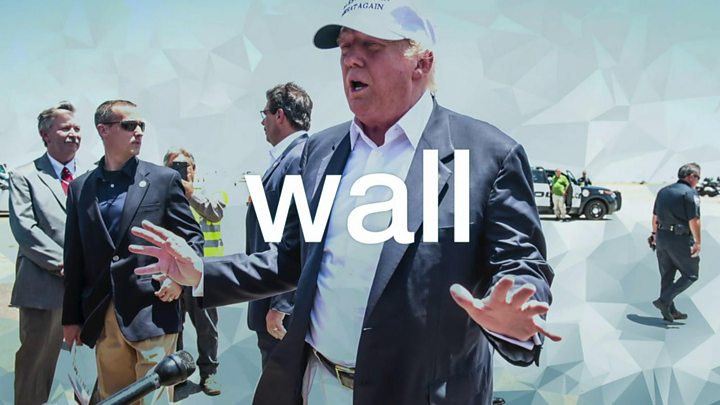


Media captionHow will President Trump deliver on border wall promise?

President Donald Trump has set in motion his plan to build an "impenetrable, physical, tall, powerful, beautiful, southern border wall" between the US and Mexico.
The border is about 1,900 miles (3,100 km) long and traverses all sorts of terrain.
Mr Trump says his wall will cover 1,000 miles and natural obstacles will take care of the rest.
But how much will it cost and who is going to foot the bill?

What is the estimated budget?

"I would build a great wall, and nobody builds walls better than me, believe me, and I build them very inexpensively."
Mr Trump claims the total cost of the wall will be $10bn (£7.5bn) to $12bn. But estimates from fact checkers and engineers seem to be universally higher.
Senate Majority Leader Mitch McConnell estimated it will cost between $12-15bn, as he addressed reporters at a Republican conference in Philadelphia.
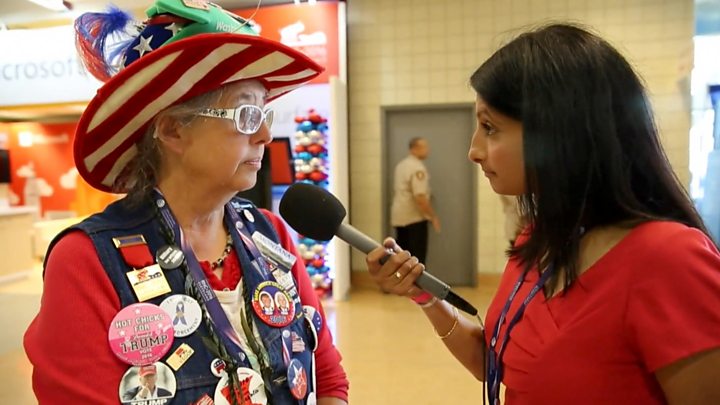


Media captionWhat Republican delegates said about Trump's wall before the election

The 650 miles of fencing already put up has cost the government more than $7bn, and none of it could be described, even charitably, as impenetrable, physical, tall, powerful or beautiful.
There are other reasons the costs would be likely to escalate beyond Mr Trump's price tag - his plans require extending the wall into increasingly remote and mountainous regions, raising the building costs substantially.
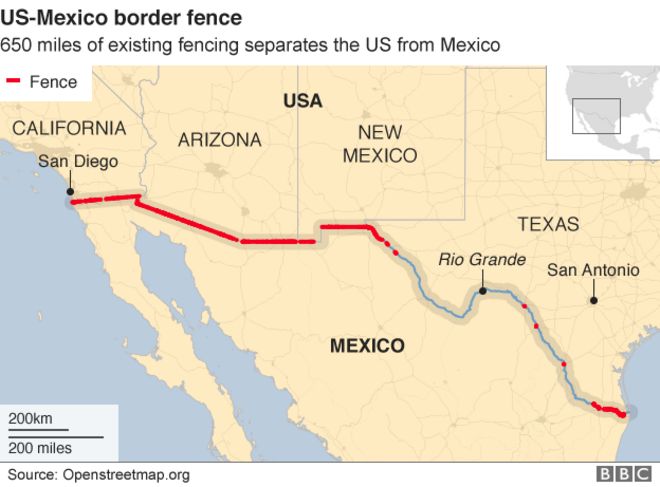
Map showing where there is already a fence between the US and Mexico border

Adding even more to the expense, the new 1,000 miles would crisscross private land, which would have to be purchased, perhaps by legal force, or financial settlements made with owners.
A study by the Washington Post estimated the cost of the president's wall would be closer to $25bn.

The row over payment

President Trump has always insisted Mexico will pay. Mexican President Enrique Pena Nieto has been equally insistent he will not.


Media captionThe US-Mexican family split by the border

Needing to fulfil his election pledge to start building on day one, Mr Trump has signed an executive order setting it in motion.
He has accepted that US taxpayers will have to cover the initial funding.
Congressional approval would be needed and Republicans have suggested a supplemental appropriations bill could be fleshed out over the next two months.

So, how would that money be recouped from Mexico?

There are a number of options, but nothing has been officially decided.
1. Raising tariffs on imports. Mr Trump's spokesman, Sean Spicer, said on 26 January that the president wanted a 20% tax on Mexican imports to pay for the wall, although he later added that it was one of several options still being considered. "By doing it that way we can do $10bn (£8bn) a year and easily pay for the wall, just through that mechanism alone," he told journalists. Forbes has argued that existing duties on Mexican goods would have to be quadrupled to pay for the whole of the wall, even if its cost were spread over 10 years. US companies would also almost certainly source products from elsewhere, reducing the revenue. The Mexican government could respond by removing tax benefits for US foreign investment. The investment totalled $101bn in 2013.
2. Remittances. Two possibilities here. President Trump could try to use laws aimed at preventing money-laundering to halt Mexicans working in the US from wiring money to families back home. The sector is huge - about $25bn a year. The hope is that the threat would cow Mexico into coughing up for the wall. The second option is to tax the remittances. Either a flat tax on all, or a far more punitive tax on those who cannot prove legal residence. But Mexicans affected by remittances might simply avoid using the wire companies and find undocumented third parties to transfer the cash.
3. Levying a "border adjustment" tax. House Republicans propose lowering corporation tax from 35% to 20% but base it on the place of consumption, not production. Imports would be taxed but not exports. A 20% tax, given the $60bn trade deficit with Mexico, would raise $12bn a year. Mexico could do little, the Washington Post reports, because border adjustments would apply to all US trading partners and would not therefore be seen as a singling out Mexico.
4. Increasing travel visa and border crossing fees. Targeting countries that have a bad record on illegal immigration, including Mexico, for higher visa fees would be popular among many Republicans. Along with increasing the fees on cars and individual people crossing the border it would raise revenue, but would probably not be enough alone.
Asked whether any of his solutions were realistic, he told the Washington Post: "It's realistic if you know something about the art of negotiating. If you have a bunch of clowns negotiating, it's not realistic."

What type of wall will he build?

Throughout his presidential campaign, Mr Trump was adamant that he would fortify the southern border with a wall ("a wall is better than fencing and it's much more powerful").
Concrete is the obvious choice. Ali F Rhuzkan, a New York-based structural engineer, estimated in an article for National Memo that a 1,900-mile wall - seemingly Mr Trump's original plan - would require about 339 million cubic feet (12.5 million cubic yards) of concrete - three times more than the Hoover Dam.
Mr Rhuzkan's estimate was based on a wall that ran 5ft beneath the ground and 20ft above. Mr Trump's claims for the wall range between 30ft and, more recently, 55ft. Even at 1,000 miles - vast amounts of concrete would be required.
That concrete, Mr Rhuzkan wrote, would need to be manufactured in slabs nearby - likely in dedicated plants - and transported to building sites, with all the enormous production and staffing costs involved.
However, since assuming office, Mr Trump's secretary of Homeland Security has said that parts of the wall will be transparent.
"There will be the physical wall and then parts of the wall that you can actually see through because it will rely on sensors and other technology," Secretary John Kelly told Fox News.

What about the environment?

Free movement between the US and Mexico is not just a human issue. What would the construction of a wall mean for animals that live near the border?
The US-Mexico border region is a delicate ecosystem with regular animal and bird migrations moving between the north and south of the American continent.
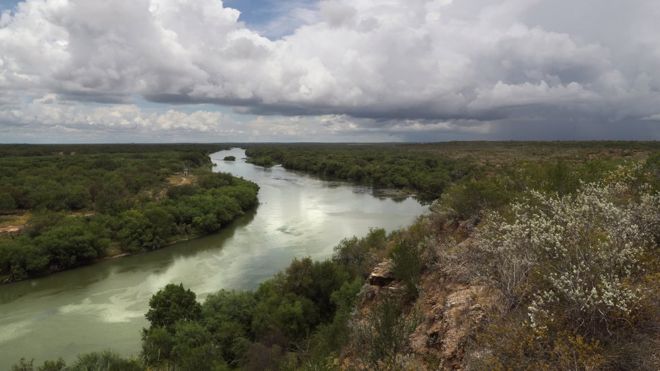
The Rio Grande flows along the U.S.-Mexico border on August 16, 2016 near Roma, Texas.Image copyrightGETTY IMAGES
Image captionThe Rio Grande flows along sections of the US-Mexico border

A number of species need to cross the border to mate with their genetically different cousins, including the endangered North American jaguar and black bears, which would be threatened without being able to mate with Mexican bears.
The wall would also have to take into account natural flooding zones as well as large areas of sand, where the ground effectively moves.
Then there is the detrimental impact to the landscape of a massive construction project - digging, road building, and the appearance of a concrete wall up to 50 feet high, notwithstanding Mr Trump's pledge that it will be "very beautiful".

martes, 3 de octubre de 2017

THE PROS AND CONS OF ADVERTISING

THE PROS AND CONS OF ADVERTISING

A CASE FOR ADVERTISING

A CASE AGAINST  ADVERTISING

 http://schoolnet.org.za/learningcircles/pubs06-2/P10/findings.html

Gun culture.


• At the White House media briefing, Press Secretary Sarah Huckabee Sanders sought to nip questions regarding gun control in the bud, insisting "there will certainly be a time for that policy discussion to take place, but that’s not the place that we’re in at this moment.” But in the same session, she raised a right-wing strawman, pointing to Chicago homicide statistics as supposed proof that gun control measures don’t necessarily save lives.
“Apparently it also is hard for Trump’s team to resist talking about policy, even when it insists that ‘today is a day for consoling the survivors and mourning those we lost,’” wrote my colleague Callum Borchers.
President Trump, of course, is at this point notorious for his relative insensitivity in the wake of terror attacks. He sought to scold London’s Muslim mayor in June as terror hit the British capital and, on the campaign trail, pointed to a mass shooting in Orlando carried out by a U.S. national of Afghan origin as justification for his ban on Muslims entering the United States.
• Regarding racial politics and gun rights in the U.S., Adam Winkler, a UCLA Law School professor, wrote a fascinating piece on the topic for The Post last year. Here’s an excerpt:
“The founding generation that adopted the Second Amendment also enacted racially discriminatory gun laws. Fearing slave revolts, early American lawmakers prohibited slaves — and often free blacks, too — from possessing weapons of any kind. Even in states where blacks were allowed to have guns, such as Virginia, they had to first obtain the permission of local officials. And while the ‘well regulated Militia’ mentioned in the Constitution largely fell out of military use, such groups continued to be employed to capture runaway slaves.
"After the Civil War, the question of guns and race changed: Many blacks from the South had obtained firearms when they fled to join colored units of the Union Army. When the war ended, the Army allowed them to keep their guns as compensation for unpaid wages. As many of those black soldiers returned to their home towns, those guns were seen by white racists as a threat to the enforcement of white supremacy. Armed blacks could fight back.
"So Southern states passed the Black Codes, which among other things barred the freedmen from possessing firearms. Racists formed groups like the Ku Klux Klan, riding at night to terrorize blacks and take away their guns. Congress, still controlled by the North, reacted by proposing the 14th Amendment to make the Bill of Rights, which previously limited only the federal government, a limit on the states, too. It was the greatest expansion of constitutional rights in American history — and, as historians have shown, it was prompted in part by the desire to protect the right of freedmen to have guns for self-defense."
• Over the weekend, Jagmeet Singh, a charismatic, 38-year-old Sikh Canadian, won the leadership race for the progressive New Democratic Party, the third-largest in Canada. He cuts a fascinating figure on the electoral scene, and is gearing up to challenge Prime Minister Justin Trudeau. He is the first “visible minority,”as the Globe and Mail put it, to lead a major Canadian federal party. Last month, a video of Singh calmly talking down a racist protester who thought he was Muslim went viral and won him online acclaim. But he has a hard job ahead of him, the Canadian daily reports:
"His success is rooted in the large following he has amassed in the South Asian community. But Mr. Singh's win is also being celebrated by many in the party's old guard who see the Ontario politician as a force for renewal: someone who can capture the imagination of voters and invigorate the New Democratic rank-and-file after the demoralizing losses of the past election.
"The sharply dressed, cosmopolitan, multilingual lawyer was drawn to the New Democrats through his social activism. At the age of 38, he is inheriting a party that is starved for money and has fallen significantly behind the Liberals and Conservatives in terms of donations with just two years to go before the next federal election."
• The Guardian’s soccer writer in Spain, Sid Lowe, wrote a terrific dispatch on the role that soccer giant FC Barcelona plays in the larger drama of Catalan nationalism. (For more on what has followed the region’s turbulent independence referendum, scroll down.) Here’s an excerpt from Lowe’s essay:
“They say sport and politics shouldn’t mix, by which they tend to mean other people’s politics. It’s a line Spain’s secretary of state for sport has used… but sport and politics do mix, especially with Barcelona, who the Marxist writer Manuel Vázquez Montalbán described as the ‘symbolic unarmed army of Catalonia.’
"That identification with Catalonia, while nuanced, shifting, unevenly embraced, sometimes vague and often problematic, is part of what gives Barça an explicitly socio-political dimension. It comes together, of course, in the slogan: mes que un club, more than a club. And that meant this was always going to be more than a match even if in the end it was less than one.
"In September 1976, Las Palmas came to the Camp Nou for the first Barcelona game broadcast in Catalan on Radio Barcelona. In October 1977, they were again the visitors when Barcelona invited Josep Taradellas, former head of the Catalan government, in exile since 1939, to preside over the game. ‘I’ll come on one condition,’ he said: ‘You win.’ Before the match, he told supporters they shared the ‘same faith’ he had 40 years earlier, insisting they had inherited a Barcelona ‘rooted in Catalanism’. Later in 1978, Las Palmas were again their opponents when they won the Cup for the first time since the transition to democracy, Johan Cruyff collecting the trophy from Juan Carlos. And then on Sunday, the day of the referendum, Las Palmas arrived once more. This time they said they didn’t want to be silent witnesses: they came with special shirts, Spain flags stitched to their chests."


miércoles, 13 de septiembre de 2017

TOP 20 BUSINESS AND SELLING TERMS


The following files contain basic terms related to the following language areas :


  • BUSINESS
  • BUYING 
  • SELLING
  • IMPORTING & EXPORTING
  • CONTRACTS 
  • LEGAL TERMS RELATED TO BUSINESS, ETC
  • SHOPPING - PAYMENT TERMS 


C.A.E AND C.P.E. Students REVISE these glossaries and make sure you know all these terms with their definitions Look them up in the LONGMAN DICTIONARY OF CONTEMPRARY ENGLISH to make sentences,

INTERPRETING STUDENTS 

For the PREPARATORY COURSE, these glossaries make up what has been called VOCAB AREAS
or GROUNDWORK VOCABS  These are the words you must have a translation term at the tip of your tongue for, almost without thinking . Make sure  you know what they mean . In your case, you must do what C.A.E AND C.P.E. sts must do AND MOVE A STEP FORWARD : PROVIDE the Spanish equivalent off the cuff

https://www.englishclub.com/download/PDF/EnglishClub_Top-20-Business-Vocabulary.pdf

CYBERCRIME 1

Election hacking might be more widespread than previously thought


The presidential election was fraught with problems, which potentially could be attributed to cyberattacks.

Noting that investigators have been so focused on Russian meddling in the presidential campaign that they haven't conducted a thorough probe of the state election systems that Russia targeted and that the hacking of those systems might be more expansive than originally thought.
Citing problems at the polls and puzzled poll workers on Election Day, the New York Times reported the concerns of observers, like Susan Greenhalgh, who was monitoring polls in Durham, N.C., for nonpartisan group Verified Voting. 
“It felt like tampering, or some kind of cyberattack,” the Times quoted Greenhalgh -- who was aware that e-pollbook vendor VR Systems, which provided Durham's software, had been hacked by Russians -- as saying. 
But that and similar incidents in at least 21 states have not yet be subjected to a thorough digital forensics probe, the Times reported.
The election director in Durham, Derek Bowens, told the Times, "We do not believe, and evidence does not suggest, that hacking occurred on Election Day."
But Sen. Mark Warner, D-Va., and the ranking Democrat on the Senate Intelligence Committee,called for greater scrutiny. “We must harden our cyberdefenses, and thoroughly educate the American public about the danger posed by attacks,” the Times quoted him as saying. “In other words: we are not making our elections any safer by withholding information about the scope and scale of the threat.”

TOPICS:

cybercrime

    jueves, 7 de septiembre de 2017

    THE NITTY GRITTY 
    DECLUTTERING

    Are u sure you should keep so many things in your life ?


    Why Should You Declutter?


    It’s been a rough couple of days. I haven’t delivered on prior commitments. Work pressure has been high and my relationship with Aaliyah is suffering. Altogether, it has weighed down heavily on my mind. Stress and anxiety have become second nature and my health is deteriorating. I was desperately in need of talking to someone who could truly help me in this situation.
    My friend Naomi is a professional psychologist and therefore has enough experience in dealing with these issues. I rang her up and arranged for a meeting. We met at Central Park on a beautiful sunny day to have a quiet conversation, with our take-away cups of coffee.
    I had been nervous all morning about our meeting even though she was a close friend. Deep down, however, I knew this was the right thing to do and I was not mistaken.
    Naomi listened attentively to everything I had to say. She understood how I was feeling. She asked me if I’d like to embark on a 21 day journey where I would have to make a few lifestyle changes for a better, simpler way of life. It would help me attain a new perspective and sense of calm. I readily agreed.
    If you find yourself in the same position, join me in this journey. We begin with decluttering. Decluttering of our mind, relationships and surroundings will help us clear everything unnecessary, allowing us to focus on our priorities.
    Declutter Your Surroundings.
    Ever since I can remember my grandparents had a habit of clearing out and cutting the number of material objects around them, on a weekly basis. They always told me, “Clearing your room will clear your mind.” It’s true. Decluttering your surroundings can give a sense of organization and clarity that would otherwise be unavailable in a cramped room. Remove objects that are not required or used. Clean it all out.
    What’s more, feel and show gratitude for things that you consider important. Take up the habit of writing down five things that you are thankful for every day. This will help you to truly value and appreciate your life. You could also empty your thoughts on paper.
    Declutter Your Relationships.
    Look around you. Are you surrounded by people who have your best interests at heart? Do these people prioritize you like you do them? If not, these relationships are toxic and are hampering your piece of mind. Cut it out and free yourself from its burden.
    Instead, cherish the people who support you, uplift you and are there for you in the tough times. Surround yourself with people that make you laugh. It is the best medicine. I know I’m lucky to have a safe zone in my friend group, here in New York City.
    At the same time, focus on yourself. What are you waiting for? Don’t postpone joy. Get in touch with your creative side. Take a trip to your favorite city. Do things that make you happy, rather than add to your stress. Love and respect yourself.
    Declutter Your Mind.
    In today’s day and age, our mind’s clock is constantly racing with innumerable thoughts running through our head. Take responsibility for the clutter present in your mind. Don’t blame the external environment. Alternatively, make a conscious effort to start from the root – your mind.
    Negativity acts as a barrier to peace of mind. Sometimes, the task ahead of you can look overwhelming. Instead of dwelling on the worst, break it down into manageable steps and focus your energy on constructive thinking and positive action. Let go and develop a new perspective.
    Clutter can weigh you down and cause stress, effecting every sphere of your life. Devote a little bit of your time to the task of decluttering. Each baby step when combined will have a positive impact on your life.
    See you in the comments.