viernes, 28 de septiembre de 2018

history of the english language

ENGLISH .... WHERE DOES IT COME FROM ?

ORIGINS OF THE ENGLISH LANGUAGE


History of English

This page is a short history of the origins and development of the English language
The history of the English language really started with the arrival of three Germanic tribes who invaded Britain during the 5th century AD. These tribes, the Angles, the Saxons and the Jutes, crossed the North Sea from what today is Denmark and northern Germany. At that time the inhabitants of Britain spoke a Celtic language. But most of the Celtic speakers were pushed west and north by the invaders - mainly into what is now Wales, Scotland and Ireland. The Angles came from "Englaland" [sic] and their language was called "Englisc" - from which the words "England" and "English" are derived.
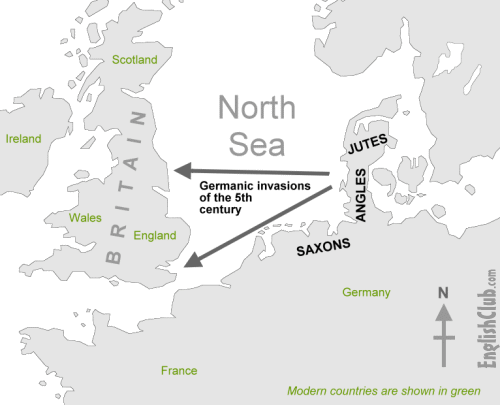
Map of Germanic invasions
Germanic invaders entered Britain on the east and south coasts in the 5th century

Old English (450-1100 AD)

The invading Germanic tribes spoke similar languages, which in Britain developed into what we now call Old English. Old English did not sound or look like English today. Native English speakers now would have great difficulty understanding Old English. Nevertheless, about half of the most commonly used words in Modern English have Old English roots. The words be, strongand water, for example, derive from Old English. Old English was spoken until around 1100.

Example of Old English
Part of Beowulf, a poem written in Old English

Middle English (1100-1500)

In 1066 William the Conqueror, the Duke of Normandy (part of modern France), invaded and conquered England. The new conquerors (called the Normans) brought with them a kind of French, which became the language of the Royal Court, and the ruling and business classes. For a period there was a kind of linguistic class division, where the lower classes spoke English and the upper classes spoke French. In the 14th century English became dominant in Britain again, but with many French words added. This language is called Middle English. It was the language of the great poet Chaucer (c1340-1400), but it would still be difficult for native English speakers to understand today.
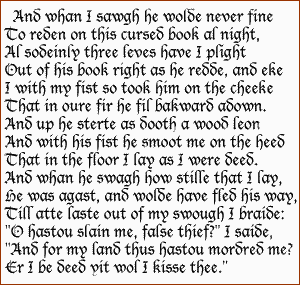
Example of Middle English
An example of Middle English by Chaucer

Modern English

Early Modern English (1500-1800)

Towards the end of Middle English, a sudden and distinct change in pronunciation (the Great Vowel Shift) started, with vowels being pronounced shorter and shorter. From the 16th century the British had contact with many peoples from around the world.
This, and the Renaissance of Classical learning, meant that many new words and phrases entered the language. The invention of printing also meant that there was now a common language in print. Books became cheaper and more people learned to read. Printing also brought standardization to English. Spelling and grammar became fixed, and the dialect of London, where most publishing houses were, became the standard. In 1604 the first English dictionary was published.
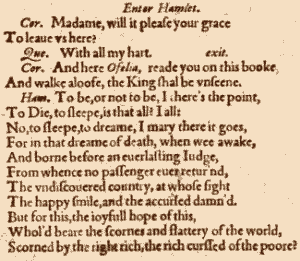
Example of Early Modern English
Hamlet's famous "To be, or not to be" lines, written in Early Modern English by Shakespeare

Late Modern English (1800-Present)

The main difference between Early Modern English and Late Modern English is vocabulary. Late Modern English has many more words, arising from two principal factors: firstly, the Industrial Revolution and technology created a need for new words; secondly, the British Empire at its height covered one quarter of the earth's surface, and the English language adopted foreign words from many countries.

Varieties of English

From around 1600, the English colonization of North America resulted in the creation of a distinct American variety of English. Some English pronunciations and words "froze" when they reached America. In some ways, American English is more like the English of Shakespeare than modern British English is. Some expressions that the British call "Americanisms" are in fact original British expressions that were preserved in the colonies while lost for a time in Britain (for example trash for rubbish, loan as a verb instead of lend, and fall for autumn; another example, frame-up, was re-imported into Britain through Hollywood gangster movies). Spanish also had an influence on American English (and subsequently British English), with words like canyon, ranch, stampede and vigilante being examples of Spanish words that entered English through the settlement of the American West. French words (through Louisiana) and West African words (through the slave trade) also influenced American English (and so, to an extent, British English).
Today, American English is particularly influential, due to the USA's dominance of cinema, television, popular music, trade and technology (including the Internet). But there are many other varieties of English around the world, including for example Australian English, New Zealand English, Canadian English, South African English, Indian English and Caribbean English.
The Germanic Family of Languages
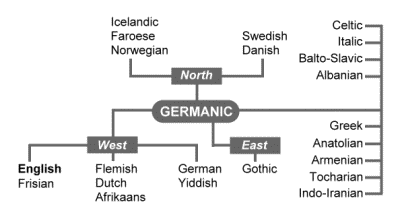
Chart of the Germanic family of languages
English is a member of the Germanic family of languages. Germanic is a branch of the Indo-European language family.
A brief chronology of English
55 BCRoman invasion of Britain by Julius CaesarLocal
inhabitants
speak
Celtish
AD 43Roman invasion and occupation. Beginning of Roman rule of Britain
436Roman withdrawal from Britain complete
449Settlement of Britain by Germanic invaders begins
450-480Earliest known Old English inscriptionsOld
English
1066William the Conqueror, Duke of Normandy, invades and conquers England
c1150Earliest surviving manuscripts in Middle EnglishMiddle
English
1348English replaces Latin as the language of instruction in most schools
1362English replaces French as the language of law. English is used in Parliament for the first time
c1388Chaucer starts writing The Canterbury Tales
c1400The Great Vowel Shift begins
1476William Caxton establishes the first English printing pressEarly
Modern
English
1564Shakespeare is born
1604Table Alphabeticall, the first English dictionary, is published
1607The first permanent English settlement in the New World (Jamestown) is established
1616Shakespeare dies
1623Shakespeare's First Folio is published
1702The first daily English-language newspaper, The Daily Courant, is published in London
1755Samuel Johnson publishes his English dictionary
1776Thomas Jefferson writes the American Declaration of Independence
1782Britain abandons its colonies in what is later to become the USA
1828Webster publishes his American English dictionaryLate
Modern
English
1922The British Broadcasting Corporation is founded
1928The Oxford English Dictionary is published

jueves, 10 de mayo de 2018

NIGHTMARISH PLASTIC

NIGHTMARISH PLASTIC

We should but can t get rid of plastic, one of the major pollutants of our time

https://www.ecowatch.com/22-facts-about-plastic-pollution-and-10-things-we-can-do-about-it-1881885971.html

viernes, 20 de abril de 2018

THE DEMS ARE FILING LAWSUIT AGAINST WHOM ?

THE CEI C65 WRITES :

Hillary Clinton looked the prospective president of the United States, but something went wrong
Trump won the elections amidst a lot of suspicions that they were rigged
Soon later, accusations against Trump mounted and several members of his cabinet were forced to resign
Trump is suspected to have tilted the election results in his favour and the Democrats hit the roof
They are not prepared to tolerate having lost when they in fact didn t Hillary , as a matter of fact, got the most votes .

READ ON .....

This is some news from THE WASHINGTON POST

 https://www.washingtonpost.com/politics/democratic-party-files-lawsuit-alleging-russia-the-trump-campaign-and-wikileaks-conspired-to-disrupt-the-2016-campaign/2018/04/20/befe8364-4418-11e8-8569-26fda6b404c7_story.html?noredirect=on&utm_term=.eaea766a5d4c&wpisrc=al_news__alert-politics--alert-national&wpmk=1


martes, 10 de abril de 2018

MARK ZUCKERBERG AT CAPITOL HILL


AN ACT OF CONTRITION  -   IS THAT ENOUGH ?

CAN HE REPAIR ALL THE DAMAGE DONE ?
CAN IT REALLY BE FIXED ?


https://www.washingtonpost.com/news/the-switch/wp/2018/04/09/facebook-chief-executive-mark-zuckerberg-to-captiol-hill-it-was-my-mistake-and-im-sorry/?noredirect=on&utm_term=.8b4a154f0502&wpisrc=al_news__alert-politics--alert-national&wpmk=1

DATA ABUSE BOUNTY THE LATEST ON FACEBOOK

Our questions is

BREACH OF PRIVACY

Should FACEBOOK ONLY CARRY THE BLAME ?

Read the article and discuss the importance of this new activity of FACEBOOK

https://newsroom.fb.com/news/2018/04/data-abuse-bounty/

martes, 3 de abril de 2018

THE FUTURE OF FIREARMS

AMERICANS, GUNS, AND THE FUTURE
Dick Metcalf has been shooting since kindergarten, a member of the NRA since middle school.  He’s been studying, writing, and teaching about firearms for over 40 years. But Metcalf’s long career as a columnist with Guns & Ammo magazine came to an abrupt halt in late 2013 after he penned a column that explored the line between firearm regulation and Second Amendment infringement. The backlash was quick and complete from what Metcalf calls the “radical extremists” of the firearms movement, a movement he’s always considered himself a part of.  Join Dick Metcalf and The Atlantic’s Ron Brownstein for a conversation about guns, culture, 

jueves, 22 de marzo de 2018

FACEBOOK S REPUTATIONAL MELTDOWN

Facebook faces a reputational meltdown

This is how it, and the wider industry, should respond
LAST year the idea took hold that Mark Zuckerberg might run for president in 2020 and seek to lead the world’s most powerful country. Today, Facebook’s founder is fighting to show that he is capable of leading the world’s eighth-biggest listed company or that any of its 2.1bn users should trust it.
News that Cambridge Analytica (CA), a firm linked to President Donald Trump’s 2016 campaign, got data on 50m Facebook users in dubious, possibly illegal, ways has lit a firestorm (see article). Mr Zuckerberg took five days to reply and, when he did, he conceded that Facebook had let its users down in the past but seemed not to have grasped that its business faces a wider crisis of confidence. After months of talk about propaganda and fake news, politicians in Europe and, increasingly, America see Facebook as out of control and in denial. Congress wants him to testify. Expect a roasting.

Latest stories

See more
Since the news, spooked investors have wiped 9% off Facebook’s shares. Consumers are belatedly waking up to the dangers of handing over data to tech giants that are run like black boxes. Already, according to the Pew Research Centre, a think-tank, a majority of Americans say they distrust social-media firms. Mr Zuckerberg and his industry need to change, fast.
The addiction game
Facebook’s business relies on three elements: keeping users glued to their screens, collecting data about their behaviour and convincing advertisers to pay billions of dollars to reach them with targeted ads. The firm has an incentive to promote material that grabs attention and to sell ads to anyone. Its culture melds a ruthless pursuit of profit with a Panglossian and narcissistic belief in its own virtue. Mr Zuckerberg controls the firm’s voting rights. Clearly, he gets too little criticism.
In the latest fiasco, it emerged that in 2013 an academic in Britain built a questionnaire app for Facebook users, which 270,000 people answered. They in turn had 50m Facebook friends. Data on all these people then ended up with CA. (Full disclosure: The Economist once used CA for a market-research project.) Facebook says that it could not happen again and that the academic and CA broke its rules; both deny doing anything wrong. Regulators in Europe and America are investigating. Facebook knew of the problem in 2015, but it did not alert individual users. Although nobody knows how much CA benefited Mr Trump’s campaign, the fuss has been amplified by the left’s disbelief that he could have won the election fairly.
But that does not give Facebook a defence. The episode fits an established pattern of sloppiness towards privacy, tolerance of inaccuracy and reluctance to admit mistakes. In early 2017 Mr Zuckerberg dismissed the idea that fake news had influenced the election as “pretty crazy”. In September Facebook said Kremlin-linked firms had spent a mere $100,000 to buy 3,000 adverts on its platform, failing at first to mention that 150m users had seen free posts by Russian operatives. It has also repeatedly misled advertisers about its user statistics.
Facebook is not about to be banned or put out of business, but the chances of a regulatory backlash are growing. Europe is inflicting punishment by a thousand cuts, from digital taxes to antitrust cases. And distrustful users are switching off. The American customer base of Facebook’s core social network has stagnated since June 2017. Its share of America’s digital advertising market is forecast to dip this year for the first time. The network effect that made Facebook ever more attractive to new members as it grew could work in reverse if it starts to shrink. Facebook is worth $493bn, but only has $14bn of physical assets. Its value is intangible—and, potentially, ephemeral.
If Mr Zuckerberg wants to do right by the public and his firm, he must rebuild trust. So far he has promised to audit some apps, restrict developers’ access to data still further, and help people control which apps have access to their data.
That doesn’t go nearly far enough. Facebook needs a full, independent examination of its approach to content, privacy and data, including its role in the 2016 election and the Brexit referendum. This should be made public. Each year Facebook should publish a report on its conduct that sets out everything from the prevalence of fake news to privacy breaches.
Next, Facebook and other tech firms need to open up to outsiders, safely and methodically. They should create an industry ombudsman—call it the Data Rights Board. Part of its job would be to set and enforce the rules by which accredited independent researchers look inside platforms without threatening users’ privacy. Software is being developed with this in mind (see article). The likes of Facebook raise big questions. How does micro-targeting skew political campaigns? What biases infect facial-recognition algorithms? Better they be answered with evidence instead of outrage.
The board or something like it could also act as a referee for complaints, and police voluntary data-protection protocols. Facebook, for example, is planning to comply worldwide with some of the measures contained in a new European law, called the General Data Protection Regulation. Among other things, this will give users more power to opt out of being tracked online and to stop their information being shared with third parties. Adherence to such rules needs to be closely monitored.
Thumbs down
Tech has experience of acting collectively to solve problems. Standards on hardware and software, and the naming of internet domains, are agreed on jointly. Facebook’s rivals may be wary but, if the industry does not come up with a joint solution, a government clampdown will become inevitable.
Facebook seems to think it only needs to tweak its approach. In fact it, and other firms that hoover up consumer data, should assume that their entire business model is at risk. As users become better informed, the alchemy of taking their data without paying and manipulating them for profit may die. Firms may need to compensate people for their data or let them pay to use platforms ad-free. Profits won’t come as easily, but the alternative is stark. If Facebook ends up as a regulated utility with its returns on capital capped, its earnings may drop by 80%. How would you like that, Mr Zuckerberg?
This article appeared in the Leaders section of the print edition under the headline "Epic fa