martes, 7 de mayo de 2019

GENDER ISSUES

She ordered an Uber. What she got was a stalker

(PHOTO ILLUSTRATION/RYAN HUDDLE, GLOBE STAFF; ADOBE STOCK IMAGES)
She usually would have walked from her house to the Prudential Center.
But it was raining. So she called an Uber. On the way to the car, she tripped over her feet.
The driver hopped out of the Lexus RX to make sure she was all right. Old enough to be her dad, he seemed nice enough. You know, not like that Uber driver arrested for allegedly raping his passenger on Storrow Drive in March.
What’s going on at the Pru, he asked.
Dinner with a girlfriend, she said.
No boyfriend, he asked.
I’d rather spend time with my dog, she joked.
Advertisement


What’s a beautiful girl like you doing running around single in Boston, he inquired.
On a 16-minute ride on a Sunday afternoon, he asked her a series of rapid-fire questions about where she was from, how long she’d lived in the city, and where she worked.
“My guard was down,” admitted Elle. (The Globe is using only her nickname at her request for safety reasons.) “He’s an old white man in a Lexus. So I think, ‘OK, you’re probably not going to kill me.’ ”
Not like the man suspected of killing a South Carolina woman who mistook his Chevy Impala for her Uber.
Women should be able to safely catch a ride-share, bus, or train without worrying we’ll enter a passenger and exit a victim. Instead, we check license plates. We text a friend when we get in and out of the ride. We look for characteristics that mark a man as “safe.”
Maybe he reminds us of our father. Perhaps he smacks of suburban privilege or he’s too polite and professional to be dangerous. We believe the stereotypes. We forget a predator wears many faces. There is no one kind when it comes to violence against women.
Advertisement


Before the driver unlocked the doors and dropped her off, he handed her his card.
Call me, he said. I’d love to take you out for a cup of coffee or glass of wine.
She wasn’t interested. But she politely said thanks the way women have been told they must in order to keep the male ego intact.
By the time she got home from dinner, she had a stalker. As she walked up the stairs to her building, she saw a piece of paper wedged in the front door.
It was a letter. From the driver. He had returned to her home while she was out.
I hope you had a nice night at the Pru. I have never done anything like this before so I really hope I am not off base. If I am, I am sorry and please disregard this.
And then he went on to talk about her “warming and energetic smile” and again invited her out for a cup of coffee or glass of wine.
The man used information he accessed through Uber and returned to her home, uninvited, and fake apologized before asking her out again.
“I could see the white paper stuffed in the door from the stairs,” she said. “I thought it was a menu so I grabbed it. But it had the name of my job written on the outside of it.”
Luckily, Elle wasn’t alone when she came home to the letter. A friend was with her.
Advertisement


“Dude, that is creepy,” she said to Elle. And it was, but she tried to shrug away the discomfort. And then she couldn’t.
That next day, Monday, she came home from work and took her dog outside for a walk. At the bottom of the stairs, she saw the driver. He was in his car, idling outside of her front door.
He hopped out to join her on the sidewalk.
I was just in the neighborhood, he said. The driver lives on the North Shore. She lives in Back Bay.
I realized that I was off base in asking you out, he said. I realized that today when you didn’t call me and I just wanted to say I’m sorry.
“I wanted to say you have no right to show up here,” she recalled wanting to tell him. “I wanted to say you should not be here. But I did not say any of those things. It’s ingrained in me not to provoke a conflict or say anything that will make someone upset, defensive or angry. I was treading lightly, walking on eggshells to say the right things to keep me safe but get away from him without offense.”
There’s no need for an apology, she said instead. But to be clear, I was not planning on calling you. I don’t want to go on a date. To be honest, we are not necessarily in the same age bracket.
The driver is 62. Elle is 34.
Advertisement


He played with her dog as she spoke. She did her best to drag the pup away and get to walking.
When she returned home, she reported him to Uber. Within an hour, she got a call from customer service. She asked no immediate action be taken to ensure he didn’t trace it back to her. They said they’d be sensitive to her concerns. They said they’d follow up.
On Tuesday, two days after her ride with the driver, two co-workers escorted her home. Elle was too scared to be alone.
But nothing happened. So by Wednesday, she’d returned to her routine.
But so did the driver. When she got home from work that evening, she walked her dog. By the time they made it to the Public Garden, there he was, waiting on the bench closest to the entrance.
She bolted. Underneath the bridge, she dialed 911. Two officers arrived — a man and a woman. She told them everything, including where to find him. The male officer asked her, more than once, if the man was Hispanic.
“I said he is an old white man with salt and pepper hair and red alcohol face,” she recounted.
The police found him on that same bench. He admitted he was waiting for Elle.
He’d been restricted by Uber, meaning he could not access the app to work. When a driver is reported, it’s a company protocol to keep them off the app while investigating to ensure passenger safety. But no one had followed up with Elle to warn her of the swift suspension.
Advertisement


The driver told the officers he was there to apologize. He hadn’t threatened her directly. So they sent him on his way. They told her they made sure he went to his car. It was parked five blocks down the street.
“He was following me,” Elle recalled. “He admitted to the police he was waiting for me. And they couldn’t do a thing, not even issue a citation.”
The female officer advised her to pick up the incident report the next day and file a restraining order. She asked that the police walk her and her dog home. They did.
She contacted Uber through their messaging system when she got home. She told them what happened. She requested a callback. Nobody called that night. No one had talked to her since Sunday.
It wasn’t until Thursday, after she told a male colleague who knew a manager at Uber, that someone from the company called her back. It took a man’s outrage for them to follow up. And all she got was another empty apology.
“What’s been described is troubling and a clear violation of our Community Guidelines,” an Uber spokesperson said in a statement to the Globe on Monday. “The driver’s access to the app was removed.”
Elle didn’t sleep in her own home for three days. After that, friends stayed with her every night for a week.
On Thursday, she filed what is called a Harassment Prevention Order. She had to miss work to do it. The order serves to protect someone from a person who is harassing, stalking, or sexually assaulting them. The order requires three or more occurrences. In cases of assault or sexual violence, it requires just one.
It was a temporary protection. She had to go to court two weeks later to make it permanent.
According to the National Coalition Against Domestic Violence, one in every six women has been stalked in her life. Yet they have to prove they are afraid in order to be protected. To tell a stalker no is not enough. To reject him nicely doesn’t get the job done. In Massachusetts, he has to violate your space at least three times before a court will take action.
In the days leading up to her court date, Elle’s colleagues and loved ones rallied around her. But some of the input seemed to be more about excusing him. Or questioning her behavior.
Switch up your routine.
Buy pepper spray.
He’s a 60-something from the North Shore. He’s probably harmless and just stupid.
You’re too friendly and need to be standoffish.
He’s probably going through a divorce or something.
On Friday, April 19, 19 days after she first encountered the driver, Elle showed up to court with two girlfriends. And me. The driver came with a lawyer, a woman with the same last name as his carrying a Tory Burch bag filled with the patriarchy.
Elle stood alone, in front of the judge and a courtroom of mostly strangers, and shared her truth. She was terrified of this man who would not quit coming back to her home.
His lawyer spent 20 minutes questioning the validity of her fear.
“She was just uncomfortable,” the lawyer said, drawing a distinction between discomfort and fear.
“He apologized,” the attorney declared, using the fact that Elle was friendly and had a conversation with him rather than running away as proof he wasn’t dangerous.
His lawyer claimed Elle’s need for a Harassment Prevention Order had no merit.
“I was pretty shocked I had to fight for it as hard I did,” Elle said. “I had to really prove the way that I was made to feel, and it was a woman working hard to disprove my fear. I wanted to ask her, ‘What would you do if I was your daughter or your sister or your mother or you? What would you do if you were me in this situation?’ But that wasn’t the context of the hearing.”
His defense rested on the idea that since he didn’t threaten Elle or physically harm her and apologized every time he violated her space, it was all good.
It wasn’t. Uber prohibits sexual conduct between passengers and drivers. As outlined in the company’s community guidelines, there is no flirting, no inquiring about someone’s relationship status, no commenting on physical appearance, no unwanted contact after the ride.
What was your intention, his lawyer asked him. The driver barked the one and only word he said during the entire 37 minutes of the court proceedings: “Friendship.”
The judge said what Elle’s friends were thinking: “From what I heard, the only reason he didn’t come back is because she called the police.”
The Harassment Prevention Order was granted. The driver must not contact her. He must stay away from her home, her work, and 150 yards away from her — for one year. To extend it, she’ll have to go through the process all over again.
This is the best-case scenario.
“It was a lot of hoops I had to jump through,” Elle said. “What if I didn’t have the privilege? I am a woman who sort of knew what steps to take. I am a woman with means. I have a support system. I have a job that offered to relocate me, a job that allowed me to miss days of work to file the paper work and go to court.”
As it stands, women have to work hard to protect themselves from stalking and violence. As women, we are tasked with murder and rape prevention. Men are entitled to our space until we fight for it.
The system, Elle says, should be working harder to protect us.
“I would like for men to drop the act that empowered women disempower men and drop their sense of entitlement to our space and our bodies,” Elle said.
For now, she’s doing what she can to prevent danger.
Elle bought that pepper spray — it’s pink. She keeps her court order close. She texts her friends when she gets home. She shares her location with a few besties at all times.
“I feel comfort knowing they can look at their phones and see where I am at any time.”
We text each other when we get home. We share our locations. We agree to spy on each other and keep tabs on one another in an effort to keep our friends alive. This is our system of safety.
Because womanhood means a man is welcome until proven dangerous.

Jeneé Osterheldt can be reached at jenee.osterheldt@globe.com. Follow her on Twitter @sincerelyjenee.


miércoles, 10 de abril de 2019

RACE IN AMERICA 2019

Race in America 2019

Public has negative views of the country’s racial progress; more than half say Trump has made race relations worse
(iStock photo)
Most black adults have negative views about the country’s racial progressMore than 150 years after the 13th Amendment abolished slavery in the United States, most U.S. adults say the legacy of slavery continues to have an impact on the position of black people in American society today. More than four-in-ten say the country hasn’t made enough progress toward racial equality, and there is some skepticism, particularly among blacks, that black people will ever have equal rights with whites, according to a new Pew Research Center survey.
Opinions about the current state of race relations – and President Donald Trump’s handling of the issue – are also negative. About six-in-ten Americans (58%) say race relations in the U.S. are bad, and of those, few see them improving. Some 56% think the president has made race relations worse; just 15% say he has improved race relations and another 13% say he has tried but failed to make progress on this issue. In addition, roughly two-thirds say it’s become more common for people to express racist views since Trump became president.
Blacks are particularly gloomy about the country’s racial progress. More than eight-in-ten black adults say the legacy of slavery affects the position of black people in America today, including 59% who say it affects it a great deal. About eight-in-ten blacks (78%) say the country hasn’t gone far enough when it comes to giving black people equal rights with whites, and fully half say it’s unlikely that the country will eventually achieve racial equality.
Nonwhites are more likely to see advantages in being whiteAmericans see disadvantages for blacks and Hispanics in the U.S. A majority of all adults (56%) say being black hurts people’s ability to get ahead at least a little, and 51% say the same about being Hispanic. In contrast, 59% say being white helps people’s ability to get ahead. Views about the impact of being Asian or Native American are more mixed.
Blacks, Hispanics and Asians are more likely than whites to say being white helps people’s ability to get ahead at least a little. Among whites, those who are more educated, as well as those who identify with or lean toward the Democratic Party, are particularly likely to see advantages to being white.
The nationally representative survey of 6,637 adults was conducted online Jan. 22-Feb. 5, 2019, in English and Spanish, using Pew Research Center’s American Trends Panel.1 In addition to exploring the public’s views about the state of race relations and racial inequality in America, the survey also looks at personal experiences with racial and ethnic discrimination and the role race plays in people’s lives. Among the report’s key findings:

Most Americans say it’s now more common for people to express racist or racially insensitive views; more than four-in-ten say it’s more acceptable

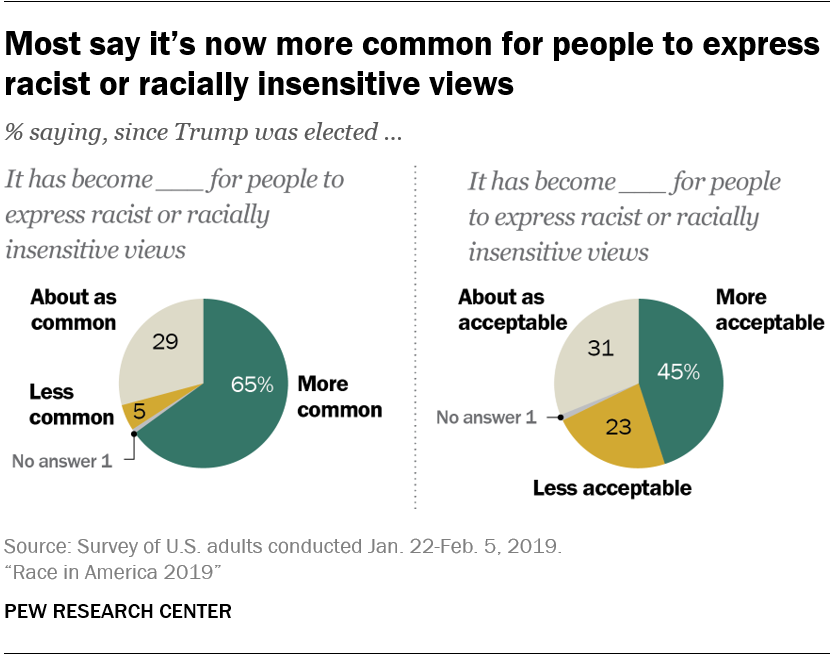
Most say it’s now more common for people to express racist or racially insensitive viewsMost Americans (65%) – including majorities across racial and ethnic groups – say it has become more common for people to express racist or racially insensitive views since Trump was elected president. A smaller but substantial share (45%) say this has become more acceptable.
Democrats and those who lean Democratic are more likely than Republicans and Republican leaners to say it has become more common and more acceptable for people to express racist and racially insensitive views since Trump was elected president. Among Democrats, 84% say this is now more common and 64% say it’s more acceptable; fewer than half of Republicans say it has become more common (42%) and just 22% say it has become more acceptable for people to express these types of views.

Views of Trump’s handling of race relations are far more negative than views of how Obama handled the issue

A majority of U.S. adults say Trump has made race relations worseA majority of Americans (56%) say Trump has made race relations worse; just 15% say he has made progress toward improving race relations, while 13% say he has tried but failed to make progress and 14% say he hasn’t addressed this issue. In contrast, 37% say Barack Obama made progress on race relations when he was president, and 27% say he tried but failed.2 A quarter of Americans say Obama made race relations worse. These retrospective views of Obama’s handling of race relations are nearly identical to views expressed during Obama’s last year in office.
Not surprisingly, assessments of Trump’s and Obama’s handling of race relations differ considerably along partisan lines. Democrats overwhelmingly say Trump has made race relations worse (84%), including large shares of black (79%) and white (86%) Democrats. Views are more divided among Republicans. About a third of Republicans (34%) say Trump has improved race relations and 25% say he has tried but failed to make progress; 19% of Republicans say he hasn’t addressed the issue, while 20% say he has made race relations worse.
When it comes to views of Obama’s handling of race relations, 55% of Democrats say he improved race relations during his presidency; just 8% say he made things worse. In contrast, 51% of Republicans say Obama made race relations worse, while 14% say he made progress toward improving it. As is the case with views of Trump’s handling of race relations, white and black Democrats offer somewhat similar assessments of how Obama handled this issue when he was president.

Republicans and Democrats have vastly different views on race

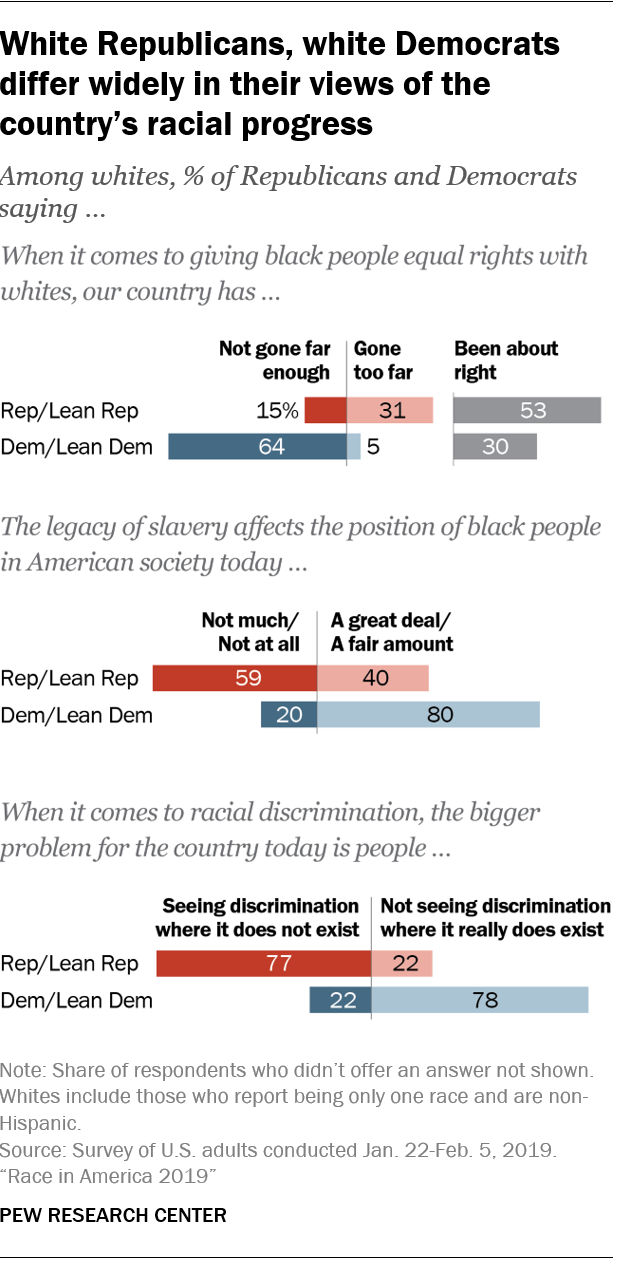
White Republicans, white Democrats differ widely in their views of the country’s racial progress In addition to being linked to views of Trump’s handling of race relations, partisanship is strongly associated with racial attitudes more broadly. In fact, after controlling for other factors, partisanship has a greater association with views about the country’s racial progress than demographic factors, though being young and more educated are also significant predictors, particularly among whites.3
Because whites and nonwhites often have widely different views of racial issues, and nonwhites disproportionately identify with or lean to the Democratic Party, gaps between Republicans and Democrats are often shown among whites in this report in order to account for differences in the racial composition of the two parties.4
White Democrats (64%) are far more likely than white Republicans (15%) to say the country hasn’t gone far enough when it comes to giving black people equal rights with whites. About half of Republicans say it’s been about right, while a sizable minority (31%) says the country has gone too far in this regard.
Eight-in-ten white Democrats – vs. 40% of white Republicans – say the legacy of slavery continues to have an impact on black people’s position in American society today. And when it comes to views about racial discrimination, 78% of white Democrats say the bigger problem is people not seeing it where it really does exist, while a similar share of white Republicans say people seeing racial discrimination where it really does not exist is the bigger problem.

Blacks are more likely than other groups to say their race has had a negative impact on their ability to get ahead; whites are the most likely to say their race helped them

About half of blacks say being black has hurt their ability to get aheadAbout half of black adults (52%) say being black has hurt their ability to get ahead at least a little, with 18% saying it has hurt a lot. About a quarter of Hispanics and Asians (24% each) and just 5% of whites say their race or ethnicity has had a negative impact. In turn, whites are more likely than other groups to say their racial background has helped them at least a little.
Among blacks, those with at least some college experience are more likely than those with less education to say being black has hurt their ability to get ahead.
Education is also linked with whites’ perceptions of the impact their race has had on their ability to get ahead. Small shares of whites across educational levels say their racial background has hurt their ability to succeed, but those with a bachelor’s degree are more likely than those with less education to say being white helped them at least a little.
Across all racial and ethnic groups, more point to their own hard work than to any other attribute, including their race, their gender, the people they know or their family’s financial situation, as something that helped them get ahead.

Blacks, whites differ in assessments of why it may be harder for black people to get ahead

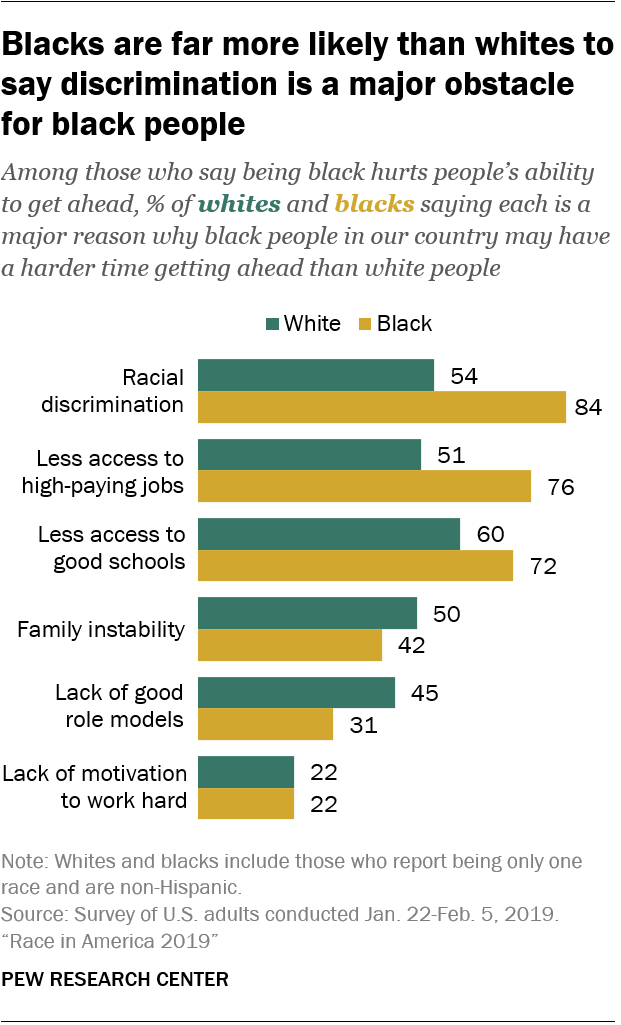
Blacks are far more likely than whites to say discrimination is a major obstacle for black peopleWhether or not they see their race as an obstacle for them personally, about two-thirds of blacks (68%) say being black generally hurts a person’s ability to get ahead in the country; 55% of whites say the same.
Among those who say being black hurts a person’s ability to get ahead, blacks are far more likely than whites to point to racial discrimination, less access to high-paying jobs and less access to good schools as major reasons why this is the case. In turn, whites are more likely than blacks to point to family instability and lack of good role models as major obstacles for black people. The same shares in both groups (22%) say a lack of motivation to work hard is to blame.
There are wide partisan gaps in these views. Most white Democrats who say being black hurts a person’s ability to succeed point to racial discrimination (70%) and less access to good schools (75%) or high-paying jobs (64%) as major reasons for this (among black Democrats, the shares are 86%, 74% and 78%, respectively). By comparison, about a third or fewer white Republicans say these are major obstacles for blacks. White Republicans are more likely than white Democrats to cite family instability, lack of good role models and a lack of motivation to work hard.

Majorities of black and white adults say blacks are treated less fairly than whites in dealing with police and by the criminal justice system

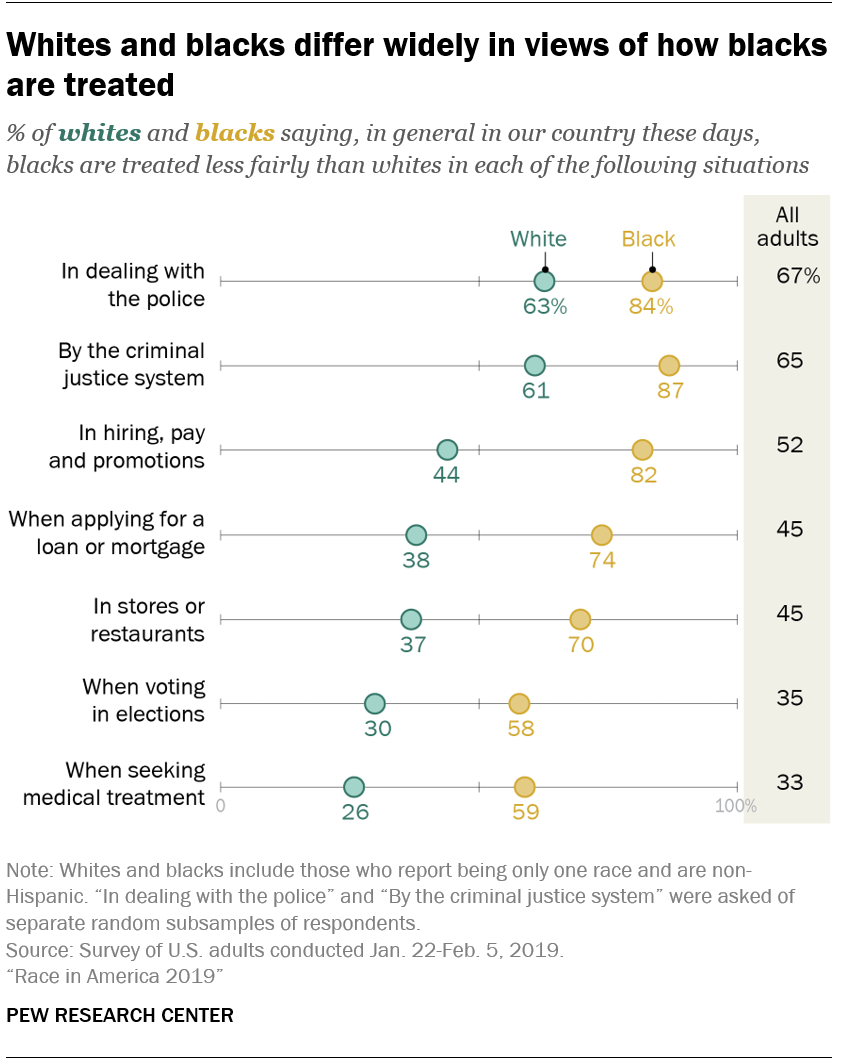
Whites and blacks differ widely in views of how blacks are treatedBlack and white adults have widely different perceptions of how blacks are treated in America, but majorities of both groups say blacks are treated less fairly than whites by the criminal justice system (87% of blacks vs. 61% of whites) and in dealing with police (84% vs. 63%, respectively).
About six-in-ten blacks or more – but fewer than half of whites – say blacks are treated less fairly than whites in hiring, pay and promotions; when applying for a loan or mortgage; in stores or restaurants; when voting in elections; and when seeking medical treatment. In each of these realms, whites tend to say blacks and whites are treated about equally; very small shares say whites are treated less fairly than blacks.
Across these different areas, there are gaps ranging from 39 to 53 percentage points in how white Democrats and white Republicans see the treatment of blacks in the U.S. About half or more white Democrats say blacks are treated less fairly than whites in dealing with the police (88% vs. 43% of white Republicans); by the criminal justice system (86% vs. 39%); in hiring, pay and promotions (72% vs. 21%); when applying for a mortgage or loan (64% vs. 17%); in stores or restaurants (62% vs. 16%); when voting in elections (60% vs. 7%); and when seeking medical treatment (48% vs. 9%).
In some of these areas, black and white Democrats express similar views, but larger shares of black Democrats say black people are treated less fairly than whites in employment situations (86%), when applying for a loan or mortgage (78%), in stores or restaurants (73%), and when seeking medical treatment (61%).

Most Americans, including similar shares of whites and blacks, say it’s never acceptable for a white person to use the N-word

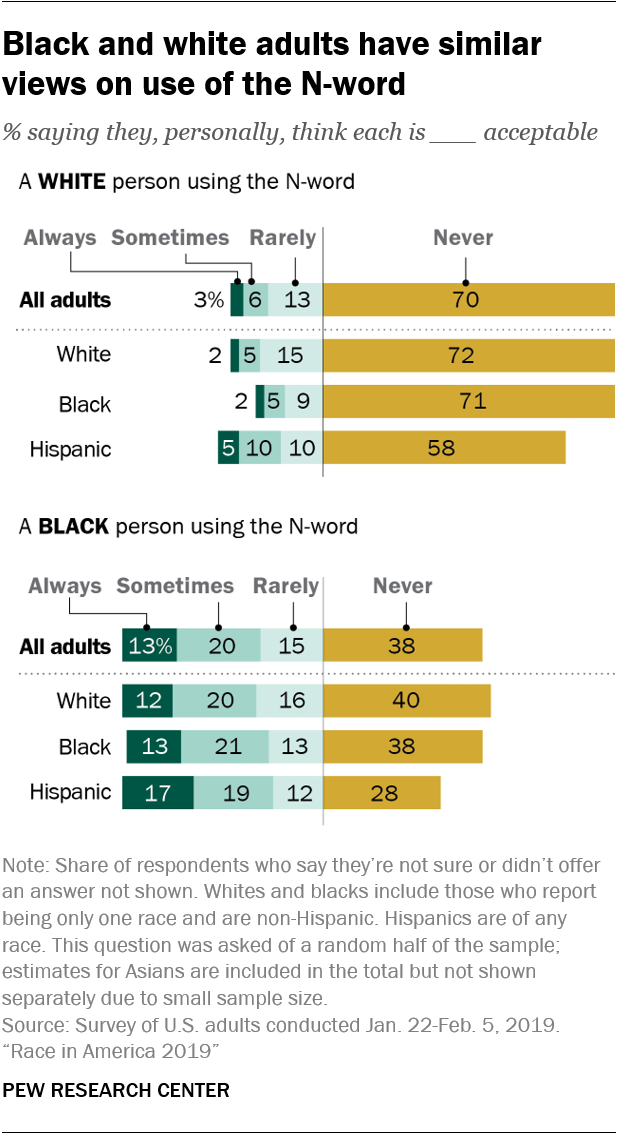
Black and white adults have similar views on use of the N-wordSeven-in-ten U.S. adults say they, personally, think it’s never acceptable for a white person to use the N-word; 13% say this is rarely acceptable and about one-in-ten say it is always (3%) or sometimes (6%) acceptable for a white person to use the N-word. Roughly seven-in-ten whites and blacks say this is never acceptable.
A smaller share of Hispanics (58%) say it’s never acceptable for a white person to use the N-word, but this is driven in part by the relatively large share of foreign-born Hispanics (28%) who say they are not sure whether it’s acceptable for a white person to use the N-word. Among Hispanics born in the U.S., 67% say this is never acceptable.
When it comes to black people using the N-word, about four-in-ten adults – including similar shares of blacks and whites – say they, personally, think it is never acceptable; 15% say it is rarely acceptable and about a third say it’s always (13%) or sometimes (20%) acceptable for black people to use the N-word.

Most black adults say being black is extremely or very important to how they think about themselves

Blacks are more likely than other groups to see their race or ethnicity as central to their identityBlacks are more likely than Hispanics or Asians – and much more likely than whites – to say that their race is central to their identity. About three-quarters of black adults say being black is extremely (52%) or very (22%) important to how they think of themselves; 59% of Hispanics and 54% of Asians say being Hispanic or Asian, respectively, is at least very important to their overall identity, with about three-in-ten in each group saying it’s extremely important. In contrast, just 15% of whites say being white is very or extremely important to how they think of themselves; about two-thirds say it’s either only a little important (18%) or not important at all (47%).
Whites and blacks younger than 30 are less likely than their older counterparts to say their race is at least very important to their overall identity. Some 64% of black adults ages 18 to 29 say being black is at least very important, compared with roughly three-quarters or more among older age groups. And while relatively few whites across age groups say being white is central to how they think about themselves, whites younger than 30 are among the least likely to say so.
Among Hispanics, those born abroad are more likely than those born in the U.S. to say being Hispanic is at least very important to how they think of themselves (65% vs. 52%).

Majorities of blacks, Hispanics and Asians say they have experienced discrimination because of their race or ethnicity

About three-quarters of blacks (76%) and Asians (75%) – and 58% of Hispanics – say they have experienced discrimination or have been treated unfairly because of their race or ethnicity at least from time to time. In contrast, about two-thirds of whites (67%) say they’ve never experienced this.
When asked about specific situations they may have experienced because of their race or ethnicity, blacks are considerably more likely than whites, Hispanics or Asians to say that people have acted as if they were suspicious of them; people have acted as if they thought they weren’t smart; they have been treated unfairly by an employer in hiring,  pay or promotion; or they have been unfairly stopped by police. Hispanics and Asians are more likely than whites to say each of these have happened to them.
Asians are more likely than any other group to say they have been subject to slurs or jokes because of their race or ethnicity. In turn, more whites than blacks, Hispanics or Asians say people have assumed they were prejudiced or racist; 45% of whites have had this experience.
Most blacks say someone has acted suspicious of them or as if they weren’t smart

For Hispanics, skin color is associated with experiences with discrimination

The survey asked black and Hispanic respondents to id