jueves, 21 de mayo de 2020

ANIMAL HIRE

WELCOME TO THE ANIMAL COMPANY

Animal Hire

The Animal Company offers a comprehensive range of trained animals for hire, for use in Film, TV, Advertising and still photography. Uniquely many of the animals we work with are privately owned by us.
However if we do not have what you are looking for, The Animal Company has access to hundreds of different species via our network of animal experts throughout the country.
Specialising in animal hire, based in the Midlands area. This gives quick and easy access to London, and also the North. As part of our service we ensure that all animals are accompanied by experienced handlers.
All events and productions carry public liability insurance, and are fully risk assessed.
Animal Welfare is of up most priority, which is why we work closely with DEFRA and Animals in Transit to ensure the highest standards of care. This means we always provide healthy, happy animals, and we are delighted to supply exotic, traditional farm and domestic animal hire.
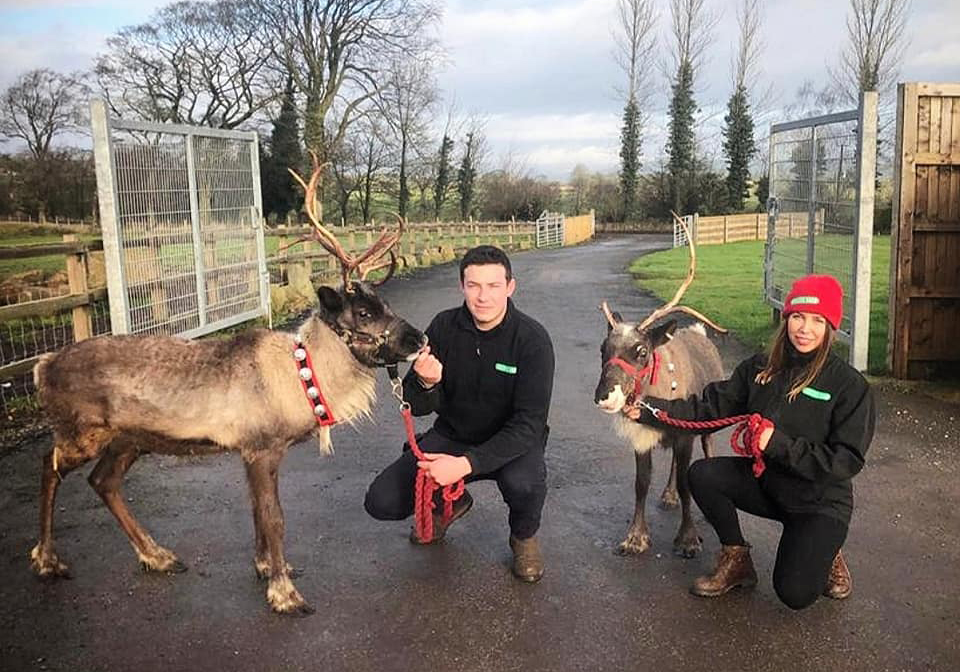
We are delighted to provide a fantastic range of animals for hire, ranging from reindeer hire, horse hire, camel hire, penguin hire and much more.
The Animal Company is the UK’s fastest growing animal hire firm, supplying trained animals for Film and TV, Promotional, Media & Events. This year we have launched www.themobilepettingfarm.co.uk which has proved a great success and enabled us to work for some of the top named brands, our mobile petting farm animals have even visited Royalty and The Ritz, London (The first ever animals to visit the Ritz in over 100 years).
Please contact our team today to discuss our animals for hire and how we can help provide the right animals for your film, TV show, advertising shoot or event.

ANIMALS WE HAVE PREVIOUSLY PROVIDED FOR OUR CLIENTS INCLUDE...

• Cows      •  Sheep      • Snakes      • Goats      • Reindeer      • Birds of Prey      • Owls      • Horses      • Camels      • Dogs / Puppies      • Cats / Kittens      • Pigs      • Huskies / Wolves      • Penguins      • Monkeys      • Rabbits      • Chickens      • Ducks      • Parrot      • Meerkats      • Alpacas      • Llamas      • Buffalo      • Racoon      • Tortoise      • Mouse      • Frog

OUR CLIENTS

OUR LATEST POSTS

miércoles, 1 de abril de 2020

CORONA LONELINESS

Dan Blazer and his wife were sheltering at home in North Carolina when their neighbors, a couple in their 50s, reached out by email last week to reassure the 76-year-old and his wife that they weren’t alone. Another couple phoned to check in.
“We’re older and we’re perfectly healthy and perfectly independent,” Blazer said. Still, he’s been a bit lonely of late, and appreciated the effort.
“Knowing these people are out there makes a huge difference,” he said.
Blazer is well-aware of the effects of loneliness and isolation — he’s spent years studying it as a psychiatrist and epidemiologist at Duke University. He chaired a committee convened by the National Academies of Sciences, Engineering, and Medicine that last month released a 281-page report on social isolation and loneliness in older adults. That report found that loneliness is tied to an increased risk of heart disease and stroke, dementia, high cholesterol, diabetes, and poor health in general. People who are lonely are also more likely to use alcohol and tobacco and exercise less.
Blazer agrees with the public health consensus — the best thing you can do for yourself and your community during the Covid-19 pandemic is to isolate yourself. But for some individuals, the side effects of doing so “could be disastrous,” Blazer said.
In its starkest sense, complete social isolation is used regularly by prisons as a severe punishment. But numerous studies show that even in everyday life, loneliness — the painful perception of not having meaningful connections with others — has serious health effects.
One of the earliest such studies was published in the American Journal of Epidemiology in 1979. Researchers followed nearly 7,000 people in Alameda County in California over a nine-year period and found that death rates were twice as high among people who lacked social and community ties, and that was after accounting for health, socioeconomic status, smoking, level of physical activity, and other factors that could affect lifespan.
A 2010 meta-analysis of 148 studies involving more than 300,000 Americans confirmed that finding: The lonelier someone is, the higher that person’s risk of death. Julianne Holt-Lunstad, a Brigham Young University psychologist and an author of that study, said loneliness can be as bad for your health as smoking 15 cigarettes a day.
But the loneliness that can result from deliberate self-isolation to protect oneself or others has not been well-studied.
“Psychologically, a key dimension of loneliness is that the person who feels lonely is feeling that way in contrast to a larger group,” said Jonathan Kanter, director of the Center for the Science of Social Connection at the University of Washington.
“What is happening now is different — we are all isolating simultaneously, and even feeling a sense of solidarity in it. We’re in a massive social experiment and we don’t know what extent this earlier research applies,” said Kanter.
He says “physical distancing” would be a better term than social distancing.
“There are ways to stay connected even as we isolate ourselves from each other,” he said.
The research also isn’t clear on what the timeline of loneliness looks like — how soon it sets in, how it comes and goes, or at what point mental or physical effects start to take a toll. Still, researchers are concerned that if loneliness goes unaddressed during the pandemic, it will take its toll.
“We do know chronic levels are highly predictive of these outcomes,” said Holt-Lunstad.
When loneliness does strike, it could make people more susceptible to illness. In a 2003 study, researchers from the University of Pittsburgh asked 304 adult volunteers about their social activity, put them into hotel rooms, and then exposed the volunteers to a cold virus. Those with more social contacts were less likely to develop symptoms. One of those researchers also ran a study in which volunteers were exposed to a cold virus. Those who led more socially isolated lives reported more severe and persistent symptoms. And in another study, Ohio State University scientists found that the immune systems of socially isolated people were more likely to cause damaging inflammation when the people were deliberately stressed.
The evidence base for interventions to combat loneliness that could help those currently isolated is “less robust,” according to the NASEM report, largely because many studies have lacked control groups. There isn’t much research on how phone calls, video conferences, or social media platforms might compare to in-person conversations. For that matter, what about singing out the window, joining well-spaced dinosaur parades, playing Words with Friends, or even interacting with a robot programmed to chat with the elderly? Holt-Lunstad is working on a meta-analysis of medically designed interventions to combat loneliness in older adults.
Some studies have shown that excessive screen time can be harmful for young people, though those reports of harm are mostly related to the type of screen time or to interactions with strangers. The coronavirus pandemic has complicated that risk-benefit calculation, however.
“In normal times I’m really working hard to help people disconnect because I know the value of live interactions,” said Kanter, the University of Washington researcher. “Now I’ve pivoted because that’s not available.”
Kanter and other loneliness experts give thumbs up to video conferencing, chats, and calls with friends and loved ones, as well as virtual contacts with mental health workers. If needed, children can serve as their parents’ de facto IT department to help them get online.
“There’s clear evidence across a number of studies that older adults do well with being online if they see a utility to it,” said Linda Fried, dean of the Mailman School of Public Health at Columbia University and a reviewer of the NASEM report.
Like other loneliness researchers, Kanter has been heartened by what he’s seen so far.
“The good news is people are doing this intuitively. They’re doing what people do when we’re deprived of social contact. I think that’s great,” he said.
Experts are encouraging the public to find new ways to feel connected. Join one of the local chat groups being formed by neighborhoods around the country, or start one yourself. Call someone every day. Sign up for an “unlonely” film club. Offer to help your neighbors — remotely — with their computers. There’s a real and documented benefit to keeping these connections going once everything settles down.
“[This situation] might be a trigger for increased awareness of how lonely anyone might be,” said Blazer, who chaired the NASEM committee. “And it might stimulate group efforts that perhaps have been on the back burner to try to reach out to people to prevent this problem.”

  • Here’s some advice from a stuck-at-home disabled person, with years of experience:
    From DisabledLife.org:
    “surviving uselessness” by silent.
    Tips for surviving having nothing to do all/every day… from one who hard-learned how.
    – Try to find the good in your (newfound) purposelessness.
    – Watch no more than 6 hours of tv a day– and not every day.
    – Don’t sit there eating crap– find new, healthy, portioned snacks.
    – Have a routine, even a simple one– an hour this, an hour that… every day.
    – Don’t sleep your time away– 9 hours max. Naps no more than twice weekly.
    – Have projects to nag at you– organize, create, destroy…
    – Read, read, read, write.
    – Clean up after yourself.
    – Clean up yourself at least thrice weekly.
    – Don’t focus on downer media– unless you need to take a good emotional dump, no more than once monthly.
    – Try some new music, books, shows– stuck in a rut with nowhere (new) to explore is no place to remain.
    – Have a few weekly obligations–  faces to see.
    – Try to remake an old, good, lost friend. Repeat.
    – Learn some new skill, preferably useful– to keep your mind/hands busy.
    – Occasionally do something nice for someone who deserves it– don’t just buy them some crap.
    – Stay off Amazon/ebay– don’t blow your money trying to buy happine

martes, 31 de marzo de 2020

Luck or Fate

Peter Rose
by PETER ROSE 2 years ago in FACT OR FICTION

Do we control our own lives?

Luck or Fate

Luck and Fate

Luck. Fate. Is everything predestined or is it all down to us?
Luck is defined as –events that are beyond control. and seem subject to chance.
Fate is defined as – the ultimate agency that predetermines the course of events.
Most of us complain about having bad luck but know that a shoe lace coming untied is not bad luck, it is bad tying in first place. So what is down to luck? Or is everything preordained?
Most gambling people curse their luck when they lose but the know they made a wrong choice.
So little of our modern lives is actually random, In the days of early human hunter gatherers, the decision to turn left or right, as you leave the cave, could be random but more probably a choice made depending on wind direction or memory of where succulent berries were plentiful. While factual knowledge, especially about the local environment and the predictability of weather and food, was very limited, a great many of the actions of humans, were random in the sense of not being planned.
Our modern urbanised existence is even far more controlled and predictable than that of a cave man. So we have to question how much “luck” influences our lives. Winning the lottery is a gamble against huge odds yet you have to buy a ticket to be in with a chance, so to a tiny degree you are controlling it not luck. The random selection of numbers on your ticket rather than on the millions of other tickets has to be down to luck.
In sport, a sudden gust of wind can divert a ball only one degree yet this can influence a million dollar result. Is this luck? Or Fate? Or simply the inability to allow for the wind?
In most sports there are umpires, judges, or referees and these can make mistakes which cost one side and negate better play by the other. Is this luck or bad judgement by the officials? Many professional sports people believe such errors of judgement will even themselves out over a season of play. So the bad luck of bad decisions going against you in some games gets equalled by good luck of bad decisions going for you in others.
In horse racing, some jockeys believe being drawn in a particular starting position, on a particular course, is bad luck and affects the result. Is this true or would training the horse to race from any starting position circumvent this?
If fate were absolute then there would be very little point to any effort to do anything, endeavor would be pointless, as what is going to happen will happen what ever is done. It is observable that such a belief is false, if we do nothing and just sit and stare at the wall we die of starvation. This becomes self fulfilling only if you believed your fate was to die of starvation while staring at a wall.
So fate is not absolute and luck is variable. If we accept these statements as true the next logical question is can we influence or even control luck and fate? To say we can control fate is a contradiction, under the above definition of fate it is obvious we can not control it, but influencing it is an interesting possibility.
Controlling and influencing luck requires the ability to examine every situation, work out all the possible alternative moves that can be made, and then work out accurately the consequences of each move. Then analyze the alternative secondary moves that could be made for each possible first move. Then correctly forecast the consequences of these secondary moves. I guess this is where Artificial Intelligence, programmed to perfection with all possibilities, takes over the world. So while it is possible to intellectually influence luck and fate, it is not going to be an everyday occurrence in most of our lives.
Can our intuition, some call it the sixth sense, help influence luck. This is what many gamblers rely on, after a study of “form” and previous results. But how many gamblers get rich? As a percentage of those who try, a very small number.
Motor racing and motorcycle racing are very dangerous sports and the professional teams do everything they can to eliminate chance and minimize danger, but they still exist. One driver can walk away from a really bad crash, without any damage to himself while another can be killed by an unforeseen occurrence of a dislodged bit of machinery, smashing into his head during the crash. Given that in both these instances every effort had been made to reduce the danger from a crash, it seems luck or fate has intervened. Could this luck or fate have been influenced? Not taking part in the race or by driving slower so there was no crash, that would have influenced things. It would also negate the very reason drivers like to race.
Some people claim “divine guidance” for their actions. If we think of the definition of fate and that of a divinity, it would seem that any such divine guidance must come from the controller of fate. Thus if genuine, such guidance is fate fulfilling its chosen course. If such a controller wanted to predestine the life of every human, they would not have programmed creativity into humanity.
How much free will, real choice, do we have in our modern, interconnected and interacting world? For most adults, who live within a family unit, all our choices get limited by how they will affect the rest of the family and how they will react or even retaliate, over the choice we make. While we have the freedom to make that choice, we will also have to face the consequences. This tends to limit the amount of choice available. Expand this thought into the wider world, our every choice is limited by how others will react to what ever action we take. You can not just walk into a stream of fast moving traffic and expect to survive and so your choice or where and when you cross the road is limited.
It is a reasonable assumption that free will exists but it is limited. It is a similar reasonable assumption that pure chance, luck, also exists but it is far less frequent than people like to imagine.
Fate is harder to quantify. Some claim fate is the over riding path of an individuals life, that is set by a deity the moment they are born, but how the individual takes each step along that path, is a matter for their choice. This would imply that fate is also conditional and partial. If fate exists as a complete predestination of all our lives, what useful purpose do humans have in the progress of creation?