Sucking up carbonGreenhouse gases must be scrubbed from the air
Cutting emissions will not be enough to keep global warming in check
Print edition | Briefing
| BONN
SWEDEN’S parliament passed a law in June which obliges the country to have “no net emissions” of greenhouse gases into the atmosphere by 2045. The clue is in the wording. This does not mean that three decades from now Swedes must emit no planet-heating substances; even if all their electricity came from renewables and they only drove Teslas, they would presumably still want to fly in aeroplanes, or use cement and fertiliser, the making of which releases plenty of carbon dioxide. Indeed, the law only requires gross emissions to drop by 85% compared with 1990 levels. But it demands that remaining carbon sources are offset with new carbon sinks. In other words greenhouse gases will need to be extracted from the air.
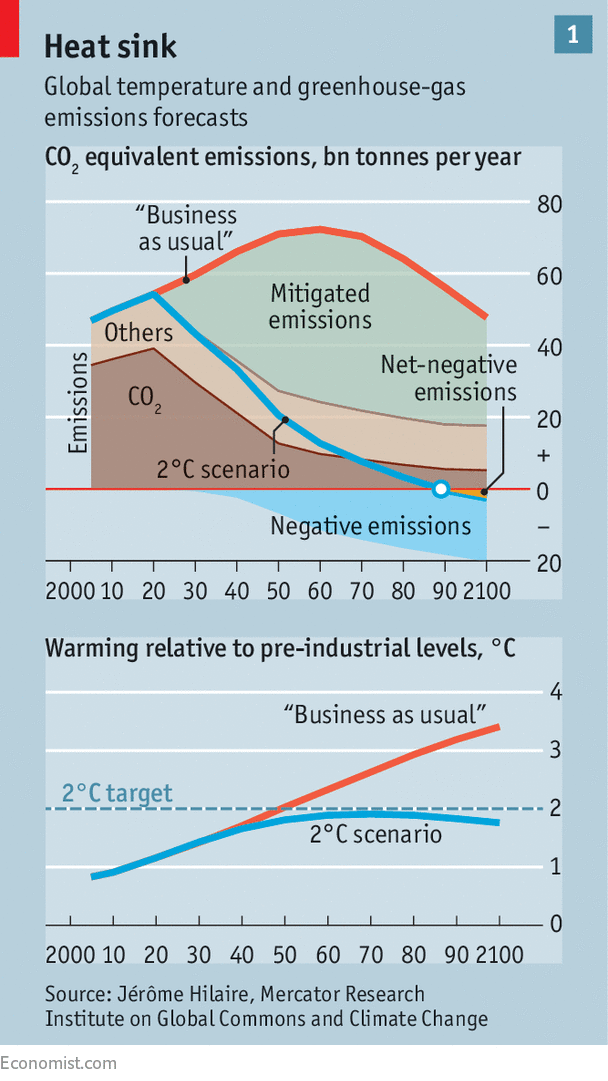
Sweden’s pledge is among the world’s most ambitious. But if the global temperature is to have a good chance of not rising more than 2ºC above its pre-industrial level, as stipulated in the Paris climate agreement of 2015, worldwide emissions must similarly hit “net zero” no later than 2090. After that, emissions must go “net negative”, with more carbon removed from the stock than is emitted.
Upgrade your inboxReceive our Daily Dispatch and Editors' Picks newsletters.
This is because what matters to the climate is the total amount of carbon dioxide in the atmosphere. To keep the temperature below a certain level means keeping within a certain “carbon budget”—allowing only so much to accumulate, and no more. Once you have spent that budget, you have to balance all new emissions with removals. If you overspend it, the fact that the world takes time to warm up means you have a brief opportunity to put things right by taking out more than you are putting in (see chart 1).
Being able to remove carbon dioxide from the atmosphere is, therefore, a crucial element in meeting climate targets. Of the 116 models the Intergovernmental Panel on Climate Change (IPCC) looks at to chart the economically optimal paths to the Paris goal, 101 assume “negative emissions”. No scenarios are at all likely to keep warming under 1.5ºC without greenhouse-gas removal. “It is built into the assumptions of the Paris agreement,” says Gideon Henderson of Oxford University.
Climate scientists like Mr Henderson have been discussing negative-emissions technologies (NETs) with economists and policy wonks since the 1990s. Their debate has turned livelier since the Paris agreement, the phrasing of which strongly suggests that countries will need to invent new sinks as well as cutting emissions. But so far politicians have largely ignored the issue, preferring to focus on curbing current flows of greenhouse gases into the atmosphere. NETs were conspicuous by their absence from the agenda of the annual UN climate jamboree which ended in Bonn on November 17th.
In the short term this makes sense. The marginal cost of reducing emissions is currently far lower than the marginal cost of taking carbon dioxide straight from the atmosphere. But climate is not a short-term game. And in the long term, ignoring the need for negative emissions is complacent at best. The eventual undertaking, after all, will be gargantuan. The median IPCC model assumes sucking up a total of 810bn tonnes of carbon dioxide by 2100, equivalent to roughly 20 years of global emissions at the current rate. To have any hope of doing so, preparations for large-scale extraction ought to begin in the 2020s.
Modellers favour NETs that use plants because they are a tried and true technology. Reforesting logged areas or “afforesting” previously treeless ones presents no great technical challenges. More controversially, they also tend to invoke “bioenergy with carbon capture and storage” (BECCS). In BECCS, power stations fuelled by crops that can be burned to make energy have their carbon-dioxide emissions injected into deep geological strata, rather than released into the atmosphere.
The technology for doing the CCS part of BECCS has been around for a while; some scenarios for future energy generation rely heavily on it. But so far there are only 17 CCS programmes big enough to dispose of around 1m tonnes of carbon dioxide a year. Promoting CCS is an uphill struggle, mainly because it doubles the cost of energy from the dirty power plants whose flues it scrubs. Other forms of low-emission electricity are much cheaper. Affixed to bioenergy generation, though, CCS does something that other forms of generation cannot. The carbon which the plants that serve as fuel originally took from the atmosphere above is sent into the rocks below, making it a negative emitter.
The problem with afforestation and BECCS is that the plants involved need a huge amount of land. The area estimated ranges from 3.2m square kilometres (roughly the size of India) to as much as 9.7m square kilometres (roughly the size of Canada). That is the equivalent of between 23% and 68% of the world’s arable land. It may be that future agricultural yields can be increased so dramatically that, even in a world with at least 2bn more mouths to feed, the area of its farms could be halved, and that the farmers involved might be happy with this turn of events. But it seems highly unlikely—and blithely assuming it can be done is plainly reckless.
Negative thinking
Less land-intensive alternatives exist—at least on paper. Some are low tech, like stimulating the soil to store more carbon by limiting or halting deep-ploughing. Others are less so, such as contraptions to seize carbon dioxide directly from the air, or methods that accelerate the natural weathering processes by which minerals in the Earth’s crust bind atmospheric carbon over aeons or that introduce alkaline compounds into the sea to make it absorb more carbon dioxide.
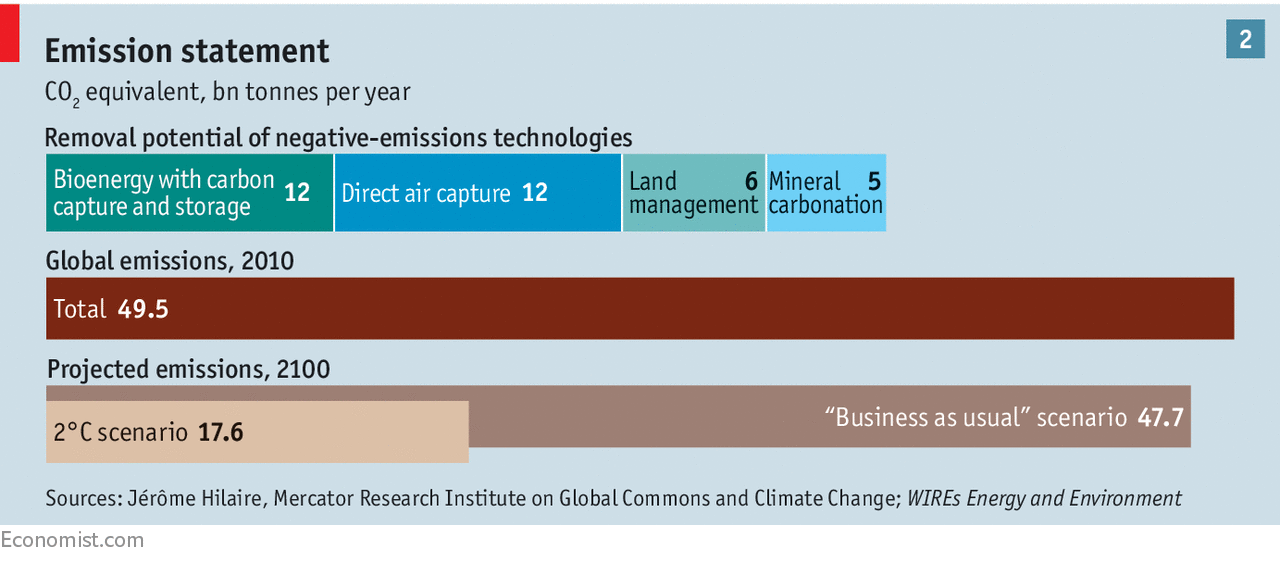
According to Jennifer Wilcox of the Colorado School of Mines, and her colleagues, the technology with the second-highest theoretical potential, after BECCS, is direct air capture (see chart 2). This uses CCS-like technology on the open air, rather than on exhaust gases. The problem is that the concentration of carbon dioxide in the air, while very high by historical standards, is very low by chemical-engineering ones: just 0.04%, as opposed to the 10% or more offered by power-plant chimneys and industrial processes such as cement-making.
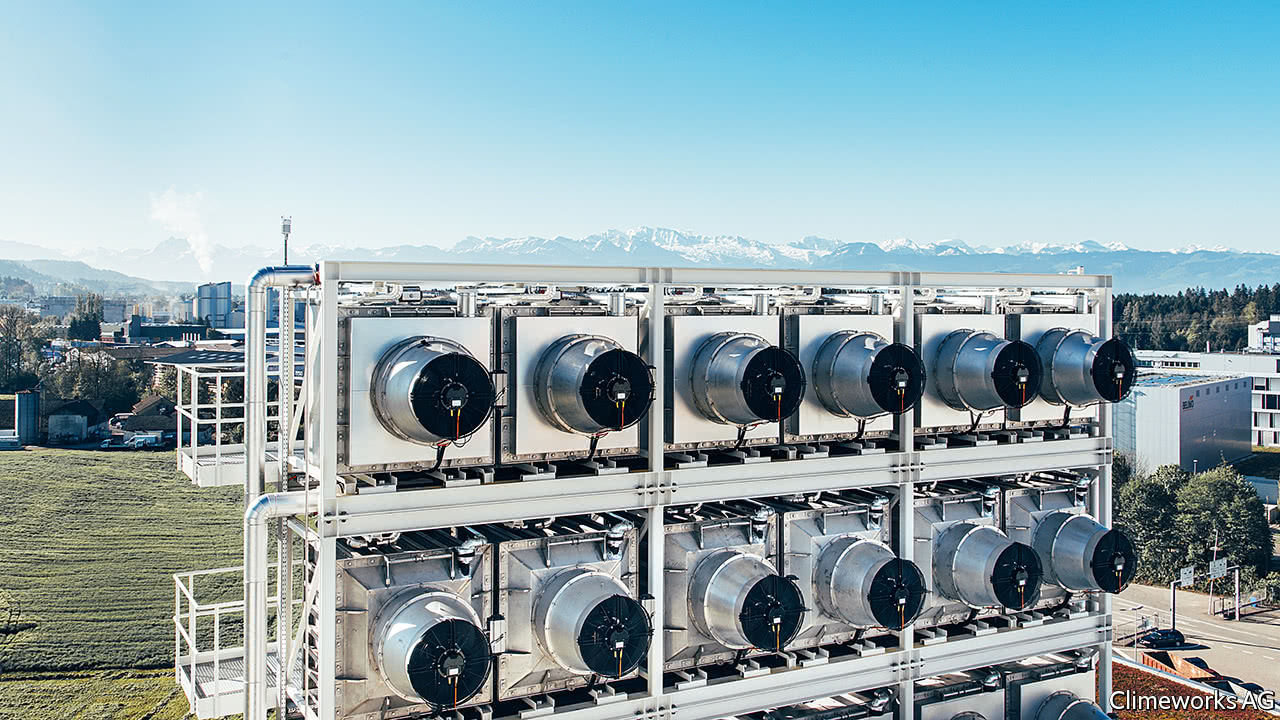
The technologies that exist today, under development by companies such as Global Thermostat in America, Carbon Engineering in Canada or Climeworks of Switzerland, remain pricey. In 2011 a review by the American Physical Society to which Ms Wilcox contributed put extraction costs above $600 per tonne, compared with an average estimate of $60-250 for BECCS.
Enhanced weathering is at an even earlier stage of development and costs are still harder to assess. Estimates range from $25 per tonne of carbon dioxide to $600. On average, 2-4 tonnes of silicate minerals (olivine, sometimes used in Finnish saunas because it withstands repeated heating and cooling, is a favourite) are needed for every tonne removed. To extract 5bn tonnes of carbon dioxide a year may require up to 20bn tonnes of minerals that must be ground into fine dust. Grinding is energy-intensive. Distributing the powder evenly, on land or sea, would be a logistical challenge to put it mildly.
Ideas abound on a small scale, in labs or in researchers’ heads, but the bigger mechanical schemes in existence today capture a paltry 40m tonnes of carbon dioxide a year. Most involve CCS and have prevented more carbon dioxide escaping into the atmosphere from fossil-burning power plants, rather than removing it. Removing 8bn-10bn tonnes by 2050, as the more sanguine scenarios envisage, let alone the 35bn-40bn tonnes in more pessimistic ones, will be a vast undertaking.
Progress will be needed on many fronts. All the more reason to test lots of technologies. For the time being even researchers with a horse in the race are unwilling to bet on a winner. Pete Smith of Aberdeen University speaks for many NETs experts when he says that “none is a silver bullet, and none has a fatal flaw.”
It will also not come cheap. WITCH, constructed by Massimo Tavoni of Politecnico di Milano, is a model which analyses climate scenarios. Unlike most simulations, it also estimates how much research-and-development funding is necessary to achieve roll-out at the sort of scale these models forecast. For all low-carbon technologies, it puts the figure at $65bn a year until 2050, four times the sum that renewables, batteries and the like attract today. Mr Tavoni says a chunk of that would obviously need to go to NETs, which currently get next to nothing.
Even the less speculative technologies need investment right away. Trees take decades to reach their carbon-sucking potential, so large-scale planting needs to start soon, notes Tim Searchinger of Princeton University. Direct air capture in particular looks expensive. Boosters note that a few years ago so did renewables. Before technological progress brought prices down, many countries subsidised renewable-energy sources to the tune of $500 per tonne of carbon dioxide avoided and often spent huge sums on it. Christoph Gebald, co-founder of Climeworks, says that “the first data point on our technological learning curve” is $600, at the lower end of previous estimates. But like the price of solar panels, he expects his costs to drop in the coming years, perhaps to as low as $100 per tonne.
However, the falling price of solar panels was a result of surging production volumes, which NETs will struggle to replicate. As Oliver Geden of the German Institute of International and Security Affairs observes, “You cannot tell the green-growth story with negative emissions.” A market exists for rooftop solar panels and electric vehicles; one for removing an invisible gas from the air to avert disaster decades from now does not.
Much of the gas captured by Climeworks and other pure NETs firms (as opposed to fossil-fuel CCS) is sold to makers of fizzy drinks or greenhouses to help plants grow. It is hard to imagine that market growing far beyond today’s total of 10m tonnes. And in neither case is the gas stored indefinitely. It is either burped out by consumers of carbonated drinks or otherwise exuded by eaters of greenhouse-grown produce.
There may be other markets, though. It is very hard to imagine aircraft operating without liquid fuels. One way to provide them would be to create them chemically using carbon dioxide taken from the atmosphere. It is conceivable that this might be cheaper than alternatives, such as biofuels—especially if the full environmental impact of the biofuels is accounted for. The demand for direct air capture spurred by such a market might drive its costs low enough to make it a more plausible NET.
From thin air
One way to create a market for NETs would be for governments to put a price on carbon. Where they have done so, the technologies have been adopted. Take Norway, which in 1991 told oil firms drilling in the North Sea to capture carbon dioxide from their operations or pay up. This cost is now around $50 per tonne emitted; in one field, called Sleipner, the firms have found ways to pump it back underground for less than that. A broader carbon price—either a tax or tradable emissions permits—would promote negative emissions elsewhere, too.
Then there is the issue of who should foot the bill. Many high-impact negative-emissions schemes make most sense in low-emitting countries, says Ms Wilcox. Brazil could in theory reforest the cerrado (though that would face resistance because of the region’s role in growing soyabeans and beef). Countries of sub-Saharan Africa could do the same in their own tropical savannahs. Spreading olivine in the Amazon and Congo river basins could soak up 2bn tonnes of carbon dioxide.
Developing countries would be understandably loth to bankroll any of this to tackle cumulative emissions, most of which come from the rich world. The latter would doubtless recoil at footing the bill, preferring to concentrate on curbing current emissions in the mistaken belief that once these reach zero, the job is done.
Whether NETs deserve to be lumped in with more outlandish “geoengineering” proposals, such as cooling the Earth with sunlight-reflecting sulphur particles in the stratosphere, is much debated. What they have in common is that they offer ways to deal with the effects of emissions that have already taken place. Proponents of small-scale, low-impact NETs, such as changes to soil management on farms, though, bridle at being considered alongside what they see as high-tech hubris of the most disturbing kind. NETs certainly inspire fewer fears of catastrophic, planetary-scale side-effects than “solar radiation management”.
But they do stoke some when it comes to the consequences of tinkering with the ocean’s alkalinity or injecting large amounts of gas underground. And the direct effects of large-scale BECCS or afforestation projects would be huge. If they don’t take up arable land, they need to take up pasture or wilderness. Either option would be a big deal in terms of both human amenity and biodiversity.
Another concern is the impact on politicians and the dangers of moral hazard. NETs allow politicians to go easy on emission cuts now in the hope that a quick fix will appear in the future. This could prove costly if the technology works—and costlier still if it does not. One study found that following a 2°C mitigation path which takes for granted NETs that fail to materialise would leave the world closer to 3°C warmer. Mr Geden is not alone in fearing that models that increasingly rely on NETs are “a cover for political inaction”.
Everything and the carbon sink
There is some progress. Academics are paying more attention. This year’s edition of “Emissions Gap”, an influential annual report from the UN Environment Programme, devotes a chapter to carbon-dioxide removal. Mr Henderson is leading a study of the subject for Britain’s Royal Society; America’s National Academy of Sciences has commissioned one, too. Both are due next spring. The IPCC will look at the technology in its special report on the 1.5ºC target, due next autumn.
There’s some money, too. Carbon Engineering has attracted backers such as Bill Gates, and now has a pilot plant in Canada. Climeworks has actually sold some carbon-offset credits—to a private investor and a big corporation—on the basis of the carbon dioxide it has squirrelled away at a demonstration plant it recently launched in Iceland. Earlier this year Britain’s government became the first to set aside some cash specifically for NETs research. In October America’s Department of Energy announced a series of grants for “novel and enabling” carbon-capture technologies, some of which could help in the development of schemes for direct air capture. Richard Branson, a British tycoon, has offered $25m to whoever first comes up with a “commercially viable design” that would remove 1bn tonnes of greenhouse gases a year for ten years.
All this is welcome, but not enough. The sums involved are trifling: £8.6m ($11.3m) in Britain and $26m from the Department of Energy. The offset sold by Climeworks was for just 100 tonnes. Mr Branson’s prize has gone unclaimed for a decade.
A carbon price—which is a good idea for other reasons, too, would beef up interest in NETs. But one high enough to encourage pricey moonshots may prove too onerous for the rest of the economy. Any price would promote more established low-carbon technologies first and NETs only much later, thinks Glen Peters of the Centre for International Climate Research in Oslo.
Encouraging CCS for fossil fuels as a stepping stone to NETs appeals to some. The fossil-fuel industry says it is committed to the technology. Total, a French oil giant, has promised to spend a tenth of its $600m research budget on CCS and related technologies. A group of oil majors says it will spend up to $500m on similar projects between now and 2027. But the field’s slow progress to date hardly encourages optimism. Governments’ commitment to CCS has historically proved fickle.
Last year Britain abruptly scrapped a £1bn public grant for an industrial-scale CCS plant which would have helped fine-tune the technology. For this to change, politicians must expand the focus of the 23-year-old UN Framework Convention on Climate Change from cutting emissions of greenhouse gases to controlling their airborne concentrations, suggests Janos Pasztor, a former climate adviser to the UN secretary-general. In other words, they must think about stocks of carbon dioxide, not just flows.
This is all the more true because emissions continue to elude control. After three years of more or less stable emissions, a zippier world economy looks on track to belch 2% more carbon dioxide this year. That amounts once again to borrowing more of the planet’s remaining carbon budget against future removal. It doesn’t take a numerate modeller like Mr Tavoni to grasp that, in his words, “If you create a debt, you must repay it.” The price of default does not bear thinking about.
Get incisive analysis on the issues that matter. Whether you read each issue cover to cover, listen to the audio edition, or scan the headlines on your phone, time withThe Economist is always well spent.
Cybercrime is defined as a crime in which a computer is the object of the crime (hacking, phishing, spamming) or is used as a tool to commit an offense (child pornography, hate crimes). Cybercriminals may use computer technology to access personal information, business trade secrets or use the internet for exploitive or malicious purposes. Criminals can also use computers for communication and document or data storage. Criminals who perform these illegal activities are often referred to as hackers.
Cybercrime may also be referred to as computer crime.
Common types of cybercrime include online bank information theft, identity theft, online predatory crimes and unauthorized computer access. More serious crimes like cyberterrorism are also of significant concern.
Cybercrime encompasses a wide range of activities, but these can generally be broken into two categories:
Crimes that target computer networks or devices. These types of crimes include viruses and denial-of-service (DoS) attacks.
Crimes that use computer networks to advance other criminal activities. These types of crimes include cyberstalking, phishing and fraud or identity theft.
The FBI identifies cybercrime fugitives who have allegedly committed bank fraud and trafficked counterfeit devices that access personal electronic information. The FBI also provides information on how to report cybercrimes, as well as useful intelligence information about the latest cybercriminals.
Many different species are used around the world, but the most common include mice, fish, rats, rabbits, guinea pigs, hamsters, farm animals, birds, cats, dogs, mini-pigs, and non-human primates (monkeys, and in some countries, chimpanzees). Video: Watch what scientists have to say about alternatives to animal testing.
Why is animal testing good for medical reasons?
The animal tests provide data on efficacy and safety. ... Testing on animals also serves to protect consumers, workers and the environment from the harmful effects of chemicals. All chemicals for commercial or personal use must be tested so that their effect on the people and animals exposed to them is understood.
What happens to animals during animal testing?
U.S. law allows animals to be burned, shocked, poisoned, isolated, starved, drowned, addicted to drugs, and brain-damaged. ... No animals are safe from experimentation—primates, dogs, rats, mice, rabbits, pigs, fish, and cats are just a few of the animals who are routinely used in these tests. You can help stop this.
Should animals be used for experiments?
There must always be a very clear scientific reason for research on animals to be considered. Through testing on animals we are able to ensure any risks of a drug are identified and minimised before it is tested on humans during clinical trials?. This helps to reduce side effects and human fatalities.
How many animals die in animal testing?
Each year, more than 100 million animals—including mice, rats, frogs, dogs, cats, rabbits, hamsters, guinea pigs, monkeys, fish, and birds—are killed in U.S. laboratories for biology lessons, medical training, curiosity-driven experimentation, and chemical, drug, food, and cosmetics testing.
Can animals feel pain during animal testing?
How Much Pain Do Animals Experience in Animal Research? Most animals experience only minimal pain or brief discomfort when they are used in research. ... Even in these cases, however, the pain is usually neither severe nor long-lasting. A small fraction of animals do experience acute or prolonged pain during experiments.
Why animals should not be tested?
The harm that is committed against animals should not be minimized because they are not considered to be "human." In conclusion, animal testing should be eliminated because it violates animals' rights, it causes pain and suffering to the experimental animals, and other means of testing product toxicity are available.
What percentage of animal tests fail?
In 2004, the FDA estimated that 92 percent of drugs that pass preclinical tests, including “pivotal” animal tests, fail to proceed to the market. More recent analysis suggests that, despite efforts to improve the predictability of animal testing, the failure rate has actually increased and is now closer to 96 percent.
Why is animal testing cruel?
Animals are deliberately sickened with toxic chemicals or infected with diseases, live in barren cages and are then killed when the experiment ends. Humans and animals are very different, so animal experiments often produce inaccurate or unusable results.
Do animals die from animal testing?
Each year, more than 100 million animals—including mice, rats, frogs, dogs, cats, rabbits, hamsters, guinea pigs, monkeys, fish, and birds—are killed in U.S. laboratories for biology lessons, medical training, curiosity-driven experimentation, and chemical, drug, food, and cosmetics testing.
Why is rat used for lab testing?
Scientists and researchers rely on mice and rats for several reasons. ... Another reason rodents are used as models in medical testing is that their genetic, biological and behavior characteristics closely resemble those of humans, and many symptoms of human conditions can be replicated in mice and rats.
Do animals feel pain?
Mammals share the same nervous system, neurochemicals, perceptions, and emotions, all of which are integrated into the experience of pain, says Marc Bekoff, evolutionary biologist and author. Whether mammals feel pain like we do is unknown, Bekoff says—but that doesn't mean they don't experience it.
What has animal testing cured?
Research in cows helped create the world's first vaccine, which in turn helped end smallpox. Studies with monkeys, dogs, and mice led to the polio vaccine. Drugs used to combat cancer, HIV/AIDS, Alzheimer's, hepatitis, and malaria would not have been possible without research with primates.
Why animal testing is better than alternatives?
Alternative testing saves the lives of animals
This replacement test, which uses donated human tissues, saves animal lives. It is more also accurate – the test can measure toxicity accurately up to 85 percent of the time, compared with only 60 to 65 percent accuracy with LD50.
The Animal Company offers a comprehensive range of trained animals for hire, for use in Film, TV, Advertising and still photography. Uniquely many of the animals we work with are privately owned by us.
However if we do not have what you are looking for, The Animal Company has access to hundreds of different species via our network of animal experts throughout the country.
Specialising in animal hire, based in the Midlands area. This gives quick and easy access to London, and also the North. As part of our service we ensure that all animals are accompanied by experienced handlers.
All events and productions carry public liability insurance, and are fully risk assessed.
Animal Welfare is of up most priority, which is why we work closely with DEFRA and Animals in Transit to ensure the highest standards of care. This means we always provide healthy, happy animals, and we are delighted to supply exotic, traditional farm and domestic animal hire.
We are delighted to provide a fantastic range of animals for hire, ranging from reindeer hire, horse hire, camel hire, penguin hire and much more.
The Animal Company is the UK’s fastest growing animal hire firm, supplying trained animals for Film and TV, Promotional, Media & Events. This year we have launched www.themobilepettingfarm.co.uk which has proved a great success and enabled us to work for some of the top named brands, our mobile petting farm animals have even visited Royalty and The Ritz, London (The first ever animals to visit the Ritz in over 100 years).
Please contact our team today to discuss our animals for hire and how we can help provide the right animals for your film, TV show, advertising shoot or event.
ANIMALS WE HAVE PREVIOUSLY PROVIDED FOR OUR CLIENTS INCLUDE...