jueves, 15 de junio de 2017

privacy

Privacy Risk with Social Media

By Sam Cohen

 Social networking has drastically changed the way people interact with their friends, associates and family members. Although social networks, like Twitter, Facebook, Google+, YouTube, Snapchat and FourSquare, play a major role in our day to day lives, I have also come to discover that they could also pose serious privacy risks. When using these social media sites, it’s quite important to know and understand the privacy risks involved. I recently had an encounter withPhilip Scala, a private investigator based in New York. Below are some of the things I learned from him on the privacy risks that comes with the use of social media. Privacy Risks on Social Media Nowadays, hackers prowl the social media networks looking for victims. They tend to use the shortened URLs like those which are created with bit.ly. They use these shortened URLs to trick their victims into visiting harmful sites or to inject viruses into their computers or mobile phones. Hackers also use spyware which they can easily install on your mobile phone, laptop, iPad or/and computer remotely via downloads, emails, shortened URLs or instant messages. The spyware gives the hacker information about the passwords you use on your social media networks and other accounts which you access online. The simplest way to avoid being a victim, is to never click on links unless you’re sure of the actual source. Most of the social media sites have information that’s required, like your birthday and email address. Identity thieves tend to gather their victims’ personal information from the information available on the social media sites. Many identity thieves tend to hack their victims email accounts by simply using the personal information available on social media profile. For instance, one of the more common techniques used by identity thieves, is clicking on the “forgot password,” and then trying to recover the password via email. Once they access your email account, they basically have access to all of your personal information. Social media sites utilize mobile apps and the location based services to allow users to check in at their current locations. This normally reveals the user’s current location to all of the people they are connected with in their particular social media networks. The information posted can be easily used by malicious people to track your whereabouts. Moreover, telling the online community where you are, or where you are going to, can end up inviting burglars and thieves to your home or business. For instance, by posting your current location and saying that you are on a long vacation in Australia, you will be letting the potential burglars or/and thieves know exactly where you are, and how long you will be gone. To mitigate such risks, you should avoid posting your travel plans, and using the location based services. Tips For Protecting Your Privacy On Social Media Create strong passwords; the stronger your passwords are, the harder it will be to guess. You can include special characters such as symbols, numbers, and capital letters in your password. Also, do not use some common passwords, like your child’s name, wife’s name or birthday. Review your social media profiles and pay close attention to the way each profile lets you protect sensitive personal details. Some social media sites like Facebook gives you the opportunity of restricting access to certain friends, family members and colleagues. Also take advantage of the enhanced privacy options which are offered by social media sites like blocking the messages from strangers. For most people, their setting is set in a way that their Facebook likes are easily visible to anyone. There are strategies that can be employed to stop people from snooping on you on Facebook. Install a good antivirus and anti-spyware; it’s essential you’ve a software that will protect you from malware, viruses, and spyware. Get the latest antivirus and anti-spyware software and make sure you have it regularly updated with all the latest malware definitions. For extra security, you can update all of the critical applications, including the operating system, your internet browsers, and such other programs which are prone to attacks. When you use social media, you are basically posting personal information online. When that information gets posted online, it is no longer private, and may end up falling into wrong hands. Even if you have put in place the highest possible security measures, some of your friends, colleagues and companies you interact with on social media, can end up leaking your personal information. Therefore, you need to be very careful about what you post online, else, you will end up giving the would-be burglars, stalkers, cyber bullies and identity thieves the information they require to cause harm. Follow Sam Cohen on Twitter: www.twitter.com/samcohenusprivacy

jueves, 23 de marzo de 2017

climatic change research is it a waste of time and money ?

The White House calls climate change research a ‘waste.’ Actually, it’s required by law

  
RALEIGH, N.C. — The day that President Trump’s climate science-slashing budget landed last week, his government held a public meeting here to prepare the nation’s Southeast region for rising seas, wildfires, extreme downpours and other impacts of climate change.
Despite White House budget director Mick Mulvaney’s assertion Friday that studying climate change is a “waste of your money,” federal scientists are required, by a 1990 law, to do just that — and are carrying on for now, even under the cloud of budgetary uncertainty created by the Trump administration.
It’s no easy task. Trump’s “skinny” budget proposes to slash many climate-related programs at agencies like NASA and the National Oceanic and Atmospheric Administration but often doesn’t go into specifics — raising doubts about the implications for climate science programs across 13 government agencies and the production of an exhaustive report about the impact of climate change in the U.S. that is required by law.
“For each of these programs, real people live on the other side of the budget line item,” said Ali Zaidi, a Stanford energy researcher who previously served in a key role in Obama’s Office of Management and Budget overseeing funding for climate and environmental programs. “Students, small business, and sources of economic growth for communities count on this data. Now you’ve got folks waiting by the phone to learn whether they’ll be going to work tomorrow or whether the data that informs their livelihoods will still be available.”
“For agencies, this means they will be less creative and more conservative,” Zaidi continued. “They will plan to the lowest possible funding level. And that will hurt both the programs and the supply chains.”
Regarding the future of the $ 2.6 billion U.S. Global Change Research Program, a White House Office of Management and Budget official said it would be “premature to speak to final funding levels prior to the full budget in mid-May.” Requests for comment to the federal climate program were not returned.
The program produces a sweeping report on how climate change is wracking different regions of the U.S. that is mandated every four years under the Global Change Research Act, signed into existence in 1990 by Republican president George H.W. Bush. The last installment of the report, released in 2014, ran over 800 pages. The next is due in 2018.
Last week’s event at North Carolina State University, aimed at drafting just one of the document’s many chapters, brought together around 50 federal researchers, university scientists, local activists, and students, among others — all working on different pieces of the climate problem in the U.S. Southeast.
U.S. regions are already preparing for climate change. The Southeast in particular faces severe threats from rising seas.
The town of Nags Head, on North Carolina’s Outer Banks, has had to grapple with the question of how and whether to close a beachside road, Seagull Drive, that has been damaged by several coastal storms.
Some residents still want to use the road and are looking at ways to protect the community from future sea level rise, said Jessica Whitehead, a geographer who works for the North Carolina Sea Grant program at North Carolina State University and is working with Nags Head on adaptation.
But the National Oceanic and Atmospheric Administration’s Sea Grant program would lose its funding under the proposed Trump budget. “From my point of view, we keep going until we’re told to stop,” Whitehead said.
Another threat to the U.S. Southeast was underscored in tragic fashion last fall in Gatlinburg, Tenn., when the resort town was engulfed by a deadly wildfire driven by a combination of strong winds and drought conditions.
“Without a doubt, the managers I talk to, say more and more, they’re seeing fire behavior that they’ve never seen before in their careers,” Kevin Hiers, a former Air Force wildfire manager turned fire researcher with the Tall Timbers Research Station and Land Conservancy in Tallahassee, said. “And that change in fire behavior definitely corresponds with weather parameters that we have not typically had on average here in the Southeast.”
Hiers, who is drafting the climate assessment’s section on Southeastern fires, acknowledged concern about climate policy and budget cuts among federal scientists.
“I think that there is a general unease in government about the future of global change research,” Hiers said. But communities in the Southeast are going to have to prepare themselves for change. “There’s such a commitment across such a broad range of public and private entities to simply prepare for contingencies. That’s all just part of strategic planning.”
The scientists at the Raleigh meeting don’t just write their reports behind closed doors. They hold public meetings around the country, bare the guts of their drafting process, hear feedback about what’s happening in communities and go back to the drawing board to make it better.
They ask communities to provide them with particular case studies of places that are being harmed by climate change or places that are innovating in their way of adapting to it. 
“They’re trying to be really constructive at a time when you’ve got the administration saying it’s a waste of money, literally,” says Anthony Janetos, a climate scientist at Boston University who served on advisory committees for the last three national assessments.
There’s a protracted process for releasing such a massive and influential document — raising fears that, if it so desires, a hostile Trump administration could derail or slow things down at many steps along the way.
First, there’s a review process in which scientists must answer not only critiques from the National Academy of Sciences, which vets the document, but also comments submitted by the public. “We are required to respond to every single comment,” explained Lynn Carter, a researcher at Louisiana State University who co-chaired the event in Raleigh and will be one of the chapter’s lead authors.
To be formally adopted as a government report, the 2014 version of the document also had to go through a review process at the White House’s Office of Management and Budget — currently leading the blueprint for slashing the federal government — which sent it out to all 13 federal agencies in the Global Change Research Program for critical review and further changes.
Any of those agencies or the White House could, presumably, balk at the report’s content and delay its formal release to Congress.
“Does that clearance process become one more fact check, or does that become a process that is more problematic?” Janetos asked. “And I just think we don’t know.”
The first test of how the thinly staffed Trump administration will handle the ongoing national assessment process could come later this year — when it will have to make decisions about the publication of a separate, more than 500 page report designed to serve as the National Climate Assessment’s scientific foundation. That fundamental climate science document recently received a largely positive peer review from the U.S. National Academies of Sciences and, if it stays on schedule, would come out in the fall of 2017, with the broader regionally focused report to follow a year later.
National Assessments have been delayed extensively in the past. After the Clinton administration produced the first one in 2000, it took until 2009to publish the second — the very early Obama years.
So as the process continues, university scientists and communities and activists around the country will be watching closely — just as they were at the meeting in Raleigh.
“With the current administration, is [the report] really going to be reviewed and are they going to have the staff to review it?” asked Karen Bearden, a volunteer with the Research Triangle branch of the climate advocacy group 350.org, during a question-and-answer session at the meeting.
“What I can tell you, this report, and the actions that are being taken to write it are being required by law,” answered Chris Avery, a contractor with the Global Change Research Program. “This is an obligatory thing.”

ECONOMY DOES AFFECT US


Economic shocks are more likely to be lethal in America

New research shows the mortality of middle-aged whites continues to rise
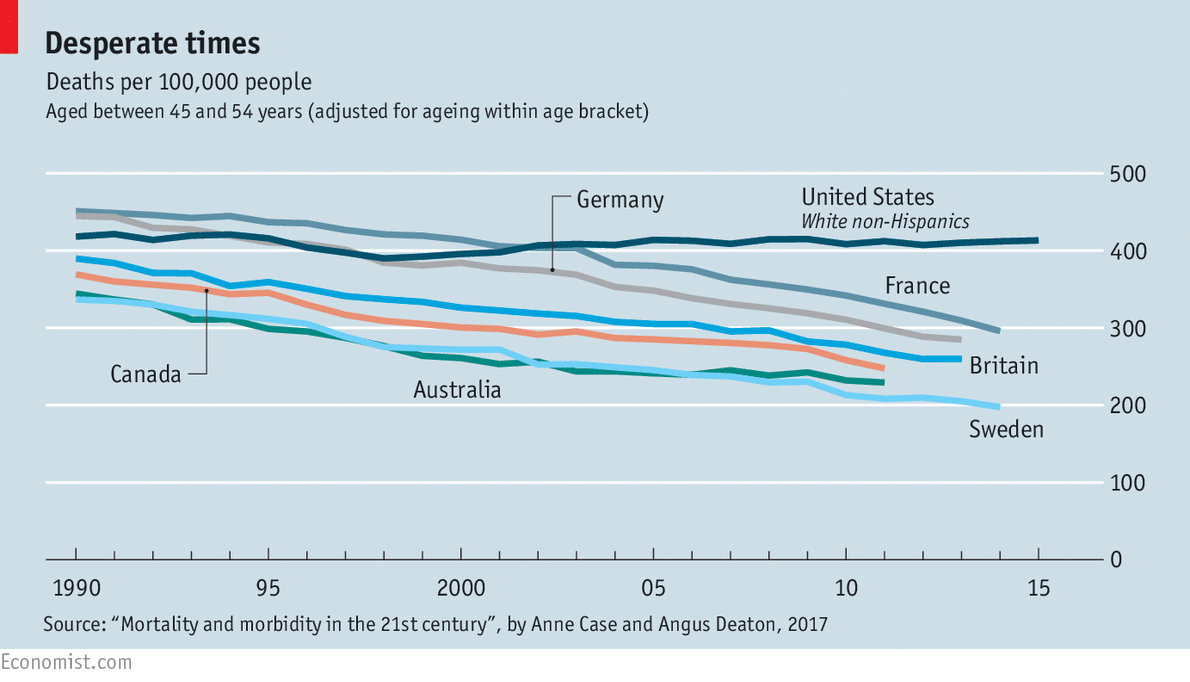
AMERICAN workers without college degrees have suffered financially for decades—as has been known for decades. More recent is the discovery that their woes might be deadly. In 2015 Anne Case and Angus Deaton, two (married) scholars, reported that in the 20 years to 1998, the mortality rate of middle-aged white Americans fell by about 2% a year. But between 1999 and 2013, deaths rose. The reversal was all the more striking because, in Europe, overall middle-age mortality continued to fall at the same 2% pace. By 2013 middle-aged white Americans were dying at twice the rate of similarly aged Swedes of all races (see chart). Suicide, drug overdoses and alcohol abuse were to blame.

Ms Case and Mr Deaton have now updated their work on these so-called “deaths of despair”. The results, presented this week at the Brookings Institution, a think-tank, are no happier. White middle-age mortality continued to rise in 2014 and 2015, contributing to a fall in life expectancy among the population as a whole. The trend transcends geography. It is found in almost every state, and in both cities and rural areas. The problem seems to be getting worse over time. Deaths from drugs, suicide and alcohol have risen in every five-year cohort of whites born since the 1940s. And in each group, ageing seems to have worse effects.

Latest updates

See all updates
You might think that rising mortality is the flipside of falling incomes. Recent trends in median per-person income for households headed by white 50- to 54-year-olds mirror their mortality rate. Income rises in the 1990s and then falls in the 2000s, ending up roughly where it started. But split people out by education, and the reflection fades. The income of college graduates has followed a similar pattern (most of the surge in the value of a college education happened before 1990). But their mortality has steadily fallen. And deaths of despair are much rarer among blacks and Hispanics, whose incomes have been on similar paths.
The authors suspect more amorphous, long-term forces are at work. The fundamental cause is still a familiar tale of economic malaise: trade and technological progress have snuffed out opportunities for the low-skilled, especially in manufacturing. But social changes are also in play. As economic life has become less secure, low-skilled white men have tended towards unstable cohabiting relationships rather than marriages. They have abandoned traditional communal religion in favour of churches that emphasise personal identity. And they have become more likely to stop working, or looking for work, entirely. The breakdown of family, community and clear structures of life, in favour of individual choice, has liberated many but left others who fail blaming themselves and feeling helpless and desperate.
Why are whites the worst affected? The authors speculate that their misery flows from their crushed aspirations. Blacks and Hispanics face worse economic circumstances, but may have had lower expectations to begin with. Or they may have taken hope from progress against discrimination. Low-skilled whites, by contrast, may find many aspects of their lives perennially disappointing. That may push them towards depression, drugs and alcohol.
American exceptionalism
Advertisement
The theory, however, does not explain why misfortune is so lethal in America. It is hardly the only place where manufacturing jobs have disappeared and the social fabric has frayed. In other English-speaking countries—Australia, Britain, Canada and Ireland—deaths of despair have risen, but not by as much. More research is needed to find out precisely what is going on. But it is not hard to see ways in which Americans are particularly vulnerable.
One example is the easy availability of opioid painkillers. Deaths from opioids more than doubled between 2002 and 2015. The epidemic is primarily found in North America. Another is access to guns, which are used in around half of suicides. However, although both these factors probably increase deaths, they cannot fully explain them. Alcohol, which kills many of those who despair, is readily available across the West.
A more likely root cause for despair is the absence of a safety net for swathes of Americans, particularly in health care. Before Obamacare financed an expansion of Medicaid (government-provided health insurance for the poor), few states provided any coverage at all for adults without dependent children. (Today, of the 19 states that did not expand Medicaid, only Wisconsin covers any childless adults.) A lack of health insurance has obvious implications for mortality when illness strikes. But it causes the healthy anguish, too. A randomised trial in Oregon found that Medicaid reduces depression rates by a third; researchers have found more personal financial strain in states that did not expand the programme. In other rich countries, people in dire straits need not worry about paying for health care.
Broader social insurance is also lacking. The help available for workers who lose their jobs is paltry compared with their lifetime income losses. As a percentage of GDP, America spends only one-fifth of the average in the OECD, a club of mostly rich countries, on training workers. It spends only a quarter of the average on financial help for the jobless. Yet Americans do not seem to build their own safety nets: 46% say they could not cover an unexpected $400 expense and would have to sell something or borrow to pay for it. A perilous economic existence and a culture which almost indiscriminately holds people responsible for their circumstances are toxic for mental well-being.
Life is unlikely to become more secure for the low-skilled. In fact, policy may soon make it more perilous. The health-care bill that lawmakers were due to vote on as The Economist went to press would vastly increase costs for the older, poorer people who are suffering the most. One avenue for reducing despair may lie in future generations of low-skilled Americans curbing their aspirations. Indeed, some of the jobless young already seem content to spend much of their leisure time playing video games. But America can surely do better than to hope for less hope.
Visit our Free exchange economics blog

View comments
Reuse this content


lunes, 16 de enero de 2017

TRUMPISM

AMERICA IS DEFINITELY CHANGING
TRUMPISM IS INAUGURATING A NEW ERA

SO WE D BETTER UNDERSTAND WHAT IT S ALL ABOUT

 https://www.theguardian.com/us-news/2016/nov/09/us-election-political-movement-trumpism

miércoles, 14 de diciembre de 2016

Legal English (Adhesion Contract or Contract of Adhesion)

 https://www.law.cornell.edu/wex/adhesion_contract_contract_of_adhesion. This webpage contains some useful information about legal drafting certified translators will need when analysing different kind of contracts which are mostly governed by the Argentine Civil and Commercial Code.

sábado, 5 de noviembre de 2016

How do thoughts and emotions impact our health?

How do thoughts and emotions impact health?

Emotions that are freely experienced and expressed without judgment or attachment tend to flow fluidly. On the other hand, repressed emotions (especially fearful or negative ones) can zap mental energy and hope and lead to health problems, such as high blood pressure or digestive disorders.
Therefore, it's important for us to recognize and identify our thoughts and emotions, and to be aware of the impact they have—not only on each other, but also on our bodies, behavior, and relationships. As our awareness increases, we find it easier to recognize what we are thinking, how we are feeling, and our attitude towards the experience. We can then choose to adjust our thoughts and emotional responses.


Negativity and physical health

Chronic stress from negative attitudes and feelings of helplessness and hopelessness can upset the body's hormone balance and deplete the brain chemicals required for feelings of happiness, as well as have a damaging impact on the immune system. New scientific understandings have also identified the process by which chronic stress can actually decrease our lifespan by shortening our telomeres (the “end caps” of our DNA strands, which play a big role in aging). 
Poorly managed or repressed anger (hostility) is also related to a slew of health conditions, such as hypertension, cardiovascular disease, digestive disorders, and infection. 


The importance of positivity

Scientist Barbara Fredrickson has shown that positive emotions have two important effects: they broaden our perspective of the world (thus inspiring more creativity, wonder, and options), and they build up over time, creating lasting emotional resilience and flourishing.
Dr. Fredrickson has spent years researching and publishing the physical and emotional benefits of positivity, including faster recovery from cardiovascular stress, better sleep,, fewer colds, and a greater sense of overall happiness. The good news is not only that positive attitudes—such as playfulness, gratitude, awe, love, interest, serenity, and feeling connected to others—have a direct impact on health and wellbeing, but that we can develop them ourselves with practice.
However, in our wish to defend against threat and loss in life, we tend to prioritize bad over good. While this is a tidy survival mechanism for someone who needs to stay hyper vigilant in a dangerous environment, the truth is that for most of us, this "negativity bias" means that we spend time ruminating over the minor frustrations we experience—bad traffic, a disagreement with a loved one—and ignoring the many chances we have to experience wonder, awe, and gratitude throughout the day.
Fredrickson has calculated that in order to offset the negativity bias and experience a harmonious emotional state, we need to experience three positive emotions for every negative one. This, she claims, can be done intentionally for those of us less “wired” to positivity.  These positive emotions literally reverse the physical effects of negativity and build up psychological resources that contribute to a flourishing life.

Forgiveness

The attitude of forgiveness—fully accepting that a negative circumstance has occurred and relinquishing negative feelings surrounding the event—can be learned and can lead us to experience better mental, emotional and physical health. The Stanford Forgiveness Project trained 260 adults in forgiveness in a 6-week course.
  • 70% reported a decrease in their feelings of hurt
  • 13% experienced reduced anger
  • 27% experienced fewer physical complaints (for example, pain, gastrointestinal upset, dizziness, etc.)
The practice of forgiveness has also been linked to better immune function and a longer lifespan. Other studies have shown that forgiveness has more than just a metaphorical effect on the heart: it can actually lower our blood pressure and improve cardiovascular health as well.
Gratitude
Acknowledging the good aspects of life and giving thanks have a powerful impact on emotional wellbeing. In a landmark study, people who were asked to count their blessings felt happier, exercised more, had fewer physical complaints, and slept better than those who created lists of hassles.
Brené Brown has found that there is a relationship between hoy and gratitude,but with a surprising twist: it’s not joy that makes us grateful, but gratitude that makes us joyful. 
Emotional resilience
Dr. Andrew Weil describes resilience as being like a rubber band—no matter how far a resilient person is stretched or pulled by negative emotions, he or she has the ability to bounce back to his or her original state. Resilient people are able to experience tough emotions like pain, sorrow, frustration, and grief without falling apart—in fact, some people are able to look at challenging times with optimism and hope, knowing that their hardships will lead to personal growth and an expanded outlook on life.
Resilient people do not deny the pain or suffering they are experiencing; rather, they retain a sense of positivity that helps them overcome the negative effects of their situation. Positive emotions have a scientific purpose—to help the body recover from the ill effects of negative emotions. Thus cultivating positivity over time can help us become more resilient in the face of crisis or stress.

jueves, 6 de octubre de 2016

GOOD NEWS FOR THE PANDA

The giant panda has long languished on the endangered species list, but an international monitoring group finally had some good news for it over the weekend.
The pandas were removed from the endangered list, along with the Tibetan antelope. But the monitors issued a grim warning about the fate of the eastern gorilla, which has moved one step closer to extinction. It also said that the plains zebra has become “near threatened” because of hunting.
The new designations were announced on Sunday in a report by the International Union for Conservation of Nature, a leading environmental group that tracks the status of plant and animal species.
Giant pandas are national symbol in China, their native habitat, and the I.U.C.N. said on Sunday that efforts by the Chinese government to reverse the slide of the population, using forest protection and reforestation, had been successful. The panda’s new designation is “vulnerable.”
The conservation union said researchers have cautiously increased estimates of the panda population in every study since 1985, but data from the most recent survey conducted between 2011 and 2014 removed any uncertainty about the rebound by the species. That study found an estimated 1,864 giant pandas in the wild, not counting cubs under the age of 18 months.
The one remaining source of concern, however, is a big one. The I.U.C.N. warned that climate change could destroy more than 35 percent of the animal’s bamboo habitat in the next 80 years, leaving its future in doubt.
Photo
A silverback mountain gorilla walked in the Bwindi Impenetrable National Park in Uganda in 2013.CreditThomas Mukoya/Reuters
“Whereas the decision to downlist the giant panda to vulnerable is a positive sign confirming that the Chinese government’s efforts to conserve this species are effective, it is critically important that these protective measures are continued, and that emerging threats are addressed,” the group wrote in its giant panda assessment.
China said it was less optimistic about the animal’s progress, however. The State Forestry Administration disputed the conservation group’s decision in a statement to The Associated Press, saying pandas struggle to reproduce in the wild and live in small groups spread widely apart.
“If we downgrade their conservation status, or neglect or relax our conservation work, the populations and habitats of giant pandas could still suffer irreversible loss, and our achievements would be quickly lost,” the forestry administration told the A.P. “Therefore, we’re not being alarmist by continuing to emphasize the panda species’ endangered status.”
The eastern gorilla has been a lot less lucky. The group changed the status of the species, one of the six great apes, from endangered to critically endangered after what it called “a devastating population decline” of more than 70 percent in the last 20 years.
The species lives in the mountains and jungles of the Democratic Republic of Congo, northwest Rwanda and southwest Uganda, and the group said long-term conflict in that part of Africa was responsible for the sharp decline in the gorilla’s numbers. The spread of firearms and militants in the wider region has also lead to an uptick in poaching and made it dangerous for conservation groups to access the area.
The eastern gorilla is composed of two subspecies whose combined population is now estimated to be fewer than 5,000, the group said.
“To see the Eastern gorilla — one of our closest cousins — slide toward extinction is truly distressing,” Inger Andersen, the Director General of the I.U.C.N. said in a statement. “Conservation action does work and we have increasing evidence of it. It is our responsibility to enhance our efforts to turn the tide and protect the future of our planet.”